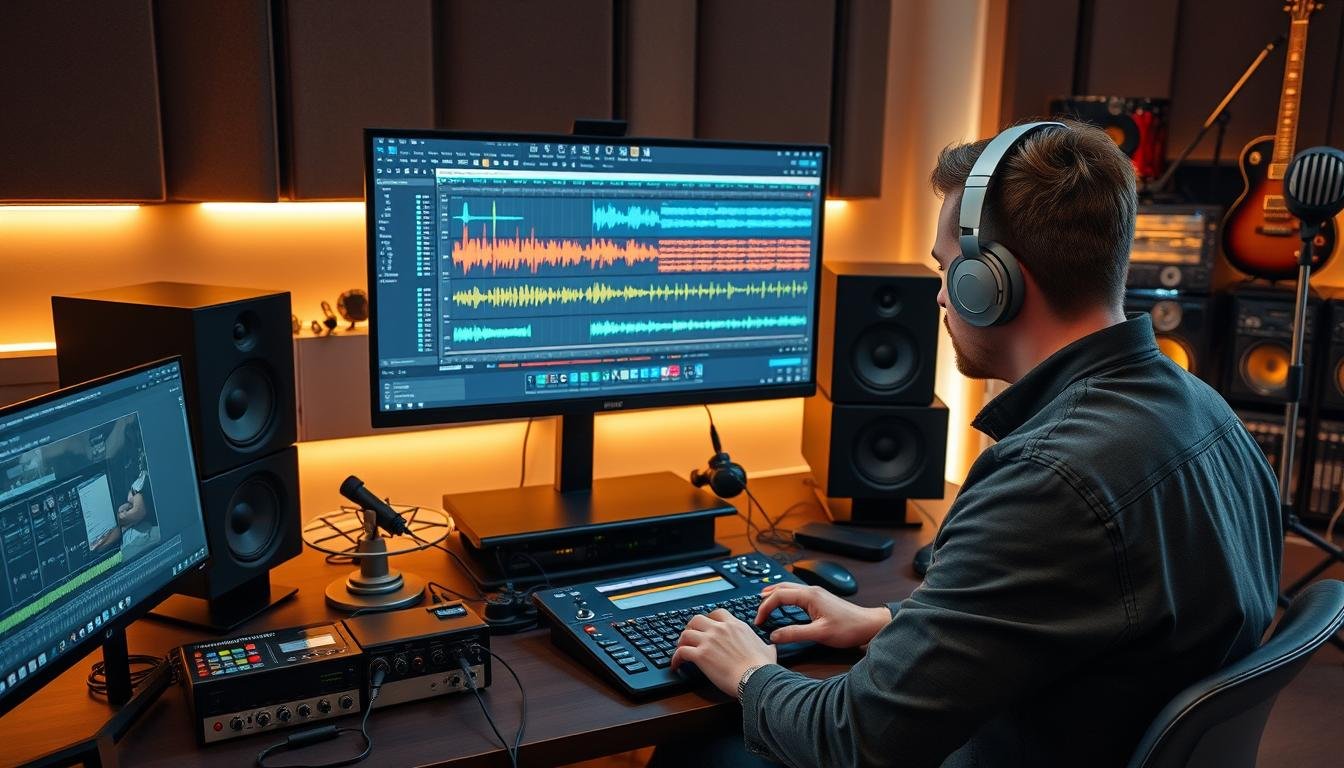


Gain staging is a key part of music production. It’s about managing audio signal levels at different stages. Knowing about gain staging is vital for making great recordings. It keeps your audio signals at the best levels, avoiding distortion and noise.
Setting the gain right from the start is important. When you record, try to reach -12 to -14 dBFS in your DAW. This keeps your signal strong and clear throughout the production.
Key Takeaways
- Gain staging starts at the source of your recording.
- Proper gain staging prevents distortion and noise.
- Aim for a level of -12 to -14 dBFS in your DAW.
- A good signal-to-noise ratio is crucial for high-quality recordings.
- Gain staging is essential for maintaining optimal signal levels.
Understanding Gain Staging Fundamentals
To make great audio, knowing about gain staging is key. Gain staging means keeping your audio at the right level at every step. This ensures your audio stays strong and clear.
The Definition of Gain Staging
Gain staging is very important in music making. It helps keep your audio quality high. It’s about controlling the gain at each step to balance strength and noise.
Key aspects of gain staging include:
- Managing gain levels at each stage of the signal path
- Maintaining an optimal balance between signal strength and noise floor
- Preventing distortion by avoiding overly high signal levels
Signal Flow Basics
Knowing about signal flow is essential for gain staging. The signal path is the journey an audio signal takes, from start to finish. It includes preamps, converters, DAWs, plugins, and output devices. Each part can change the signal’s gain, so it’s important to manage them well.
The signal flow can be broken down into several key stages:
- Input stage: This is where the audio signal is captured, typically through a microphone or instrument.
- Preamp stage: The signal is amplified to an optimal level for processing.
- Conversion stage: The analog signal is converted to digital or vice versa.
- Processing stage: The signal is processed using various plugins and effects within the DAW.
- Output stage: The final processed signal is sent to output devices like speakers or headphones.
The Goal of Proper Gain Structure
The main goal of proper gain structure is to keep the signal clean and free from distortion. This means setting the gain at each stage just right. The signal should be strong enough to beat out noise but not so strong it distorts.
Good gain staging leads to a cleaner mix with better sound range. As audio engineer Bobby Owsinski says, “Gain staging is one of the most important aspects of recording and mixing, as it sets the foundation for the entire mix.”
“Gain staging is critical because it determines the noise floor and headroom of your mix. Proper gain staging ensures that you’re getting the best possible signal-to-noise ratio.” – Bobby Owsinski
To show what gain staging is about, here’s a table of typical gain levels at different stages:
| Stage | Typical Gain Level |
|---|---|
| Input Stage | Variable, depending on the source |
| Preamp Stage | +20 dB to +60 dB |
| DAW Processing | 0 dB to +12 dB |
| Output Stage | Variable, depending on the output device |
By mastering gain staging, producers can greatly improve their mixes. They can achieve a more professional sound.
Why Gain Staging Matters in Music Production
Gain staging is key in music production. It affects your audio’s quality. It’s about managing audio signal levels through your recording and mixing setup.
Impact on Audio Quality
Your audio quality is greatly influenced by gain staging. Proper gain staging keeps your audio signals at the best levels. This reduces distortion and noise. A well-staged mix sounds cleaner and more professional.
Preventing Distortion and Noise
Gain staging helps prevent distortion and noise. Distortion happens when signals get too hot, causing an unpleasant sound. Noise can sneak in when signals are too low, picking up interference.
Creating Cleaner, More Professional Mixes
Optimal gain staging leads to cleaner, more professional mixes. It ensures each mix element is at the right level. This creates a balanced sound that sounds great on any system.
| Gain Staging Aspect | Benefit |
|---|---|
| Optimal Signal Levels | Reduces distortion and noise |
| Proper Headroom | Allows for dynamic range and prevents clipping |
| Balanced Mix | Results in a professional-sounding mix |
In conclusion, gain staging is vital in music production. It directly impacts your audio’s quality. By mastering gain staging, producers can make their mixes sound cleaner and more professional.
The Technical Side: Decibels, Headroom, and Dynamic Range
The technical side of gain staging includes decibels, headroom, and dynamic range. These are key for the best audio quality. To get it right, producers need to know how these work together in their digital audio workstation (DAW).
Understanding dB Scales (dBFS, dBVU, dBu)
Decibels measure audio levels, but the scale changes between digital and analog. In digital, gain is in dBFS, with 0 dBFS being the max before clipping. -18 dBFS is like 0 dB in analog. Knowing dB scales like dBVU and dBu is vital for understanding gain staging in different gear and software.
- dBFS: Used in digital systems to measure the level relative to the maximum possible level.
- dBVU: A standard for measuring average audio levels in analog equipment.
- dBu: Measures voltage levels in analog audio equipment.
The Concept of Headroom
Headroom is the extra gain before a signal distorts. It’s key to keep audio clean and clear. Aim for at least 6 dB of headroom to handle loud peaks without clipping.
Preserving Dynamic Range
Dynamic range is the difference between the loudest and quietest parts of a signal. Keeping this range is crucial for music’s emotional impact. Setting the right gain levels helps keep the mix dynamic and professional.
In short, mastering proper gain staging techniques means understanding decibels, headroom, and dynamic range. Grasping these concepts helps producers improve their mixes and achieve a top-notch sound.
Analog vs. Digital Gain Staging: Key Differences
Gain staging is key in audio production, with analog and digital systems needing different approaches. Knowing these differences is vital for producers working with both. It helps them get the best audio quality.
Working with Analog Equipment
Analog gear has physical limits that affect gain staging. While analog systems can handle more, they still have a limit where distortion starts. Setting the right levels in analog systems is about finding the sweet spot. It’s where you get the best signal-to-noise ratio without distortion. You need to know your gear well, as each device has its own characteristics.
Digital Audio Workstation Considerations
Digital audio workstations (DAWs) work in a fixed digital space. The max level is 0 dBFS. Going over this causes digital clipping, which sounds bad. In DAWs, it’s all about keeping levels below the max while keeping the signal-to-noise ratio good. You have to watch the gain structure from start to finish.
The Myth of “Hot” Signals in Digital
Many think digital gain staging is about making signals as high as possible. But this can lead to distortion. It’s better to have the right amount of headroom for a clean mix. Producers should find a balance between signal level and headroom. This ensures their mix sounds great on any system.
What Is Gain Staging? A Simple Explanation for Producers
Producers who get gain staging right can make their music sound better. They keep the volume levels just right from start to finish. Gain staging means managing all volume levels to get the cleanest mix possible.
Breaking Down the Process Step by Step
To grasp gain staging, break it down into simple steps. First, adjust the input gain on recording devices or interfaces to the best level. This is key for the whole gain structure.
Then, manage the gain through plugins and processing stages. Make sure the signal stays strong and clean. Lastly, adjust the output gain for mixing and mastering.
Key steps in gain staging include: setting optimal input gain, managing gain through plugins, and adjusting output gain for mixing and mastering.
Real-world Applications
Gain staging is used in recording, mixing, and mastering. It ensures a clean capture of the initial signal during recording. In mixing, it keeps the mix balanced by preventing one track from dominating.
For mastering, it’s crucial for preparing the final mix for different platforms.
For example, when recording a vocalist, the right input gain on the microphone preamp is essential. Too little gain can make the signal weak, while too much can cause distortion.
Gain Staging Workflow Examples
Here are some workflow examples to show gain staging in action. In a digital audio workstation (DAW), producers use gain plugins to adjust levels between stages. For instance, after EQ, a gain plugin can adjust levels for the compressor to get an optimal signal.
- Adjust input gain for optimal recording levels.
- Use gain plugins between processing stages to maintain signal integrity.
- Monitor levels closely during mixing to maintain a balanced mix.
By sticking to these gain staging principles, producers can get a cleaner, more professional mix. This mix will have less noise and distortion.
Common Gain Staging Mistakes to Avoid
Effective gain staging is key to a professional-sounding mix. Many producers struggle with it, often due to common mistakes. These mistakes can be avoided with the right knowledge.
Running Levels Too Hot
One big mistake is running levels too high. This can cause distortion and lose dynamic range. When levels are too high, the sound gets clipped, sounding unpleasant.
To avoid this, keep an eye on your meters. Adjust your gain as needed.
Ignoring Gain Structure Between Plugins
Ignoring gain structure between plugins is another mistake. Chaining plugins without considering gain structure can add noise and distortion. It’s important to adjust gain at each stage for a good signal-to-noise ratio.
Overlooking Input Gain
Not paying attention to input gain is a big mistake. Input gain sets the foundation for your signal chain. If it’s not right, it can cause problems later. Always make sure your input gain is optimized.
Compensating with Output Volume
Compensating with output volume is a common mistake. It might seem like a quick fix, but it can make your mix unbalanced. Instead, fix gain staging issues at the source for a balanced mix.
To show the impact of these mistakes, here’s a table:
| Mistake | Effect on Mix | Solution |
|---|---|---|
| Running Levels Too Hot | Distortion, Loss of Dynamic Range | Adjust Gain, Monitor Meters |
| Ignoring Gain Structure Between Plugins | Noise Accumulation, Distortion | Adjust Gain at Each Plugin Stage |
| Overlooking Input Gain | Poor Signal Quality, Downstream Issues | Optimize Input Gain |
| Compensating with Output Volume | Unbalanced Mix | Address Gain Staging Issues at Source |
Knowing these common mistakes and how to avoid them can greatly improve your mix quality. Proper gain staging is essential for a professional sound. Understanding its importance helps avoid these mistakes.
Gain Staging in Different Production Phases
Gain staging changes a lot in recording, mixing, and mastering. It’s key for producers to know these changes. This helps them get the best results.
During Recording
In recording, gain staging is about getting a clear signal. It’s about setting the gain right. This way, the signal is strong but not distorted by noise.
Optimal Recording Levels are between -18 dB and -12 dB. This range captures a clean signal. It’s not too quiet or too loud.
While Mixing
In mixing, gain staging keeps the mix balanced. It’s important to adjust gain between plugins. This prevents signal loss.
Gain utility plugins help keep levels right during mixing. They let producers tweak gain for better mix quality.
In the Mastering Process
In mastering, gain staging prepares the mix for distribution. It makes sure the audio sounds good on any system.
A well-mastered track balances loudness and dynamic range. VU meters and peak meters help get this balance right.
| Production Phase | Gain Staging Focus | Optimal Levels |
|---|---|---|
| Recording | Signal-to-Noise Ratio | -18 dB to -12 dB |
| Mixing | Balancing Mix Levels | -24 dB to -18 dB |
| Mastering | Loudness and Dynamic Range | -6 dB to 0 dB |
Knowing how gain staging works in each phase helps producers. It leads to better audio, less distortion, and a professional sound.
Essential Tools for Proper Gain Staging
To get your gain structure right, you need the right tools. Gain staging is key in music production. It makes your tracks clear, professional, and balanced.
VU Meters and Peak Meters
VU meters and peak meters are crucial for checking your audio levels. VU meters show the average level of your audio. They help you see how loud your audio is overall. Peak meters show the highest level of your signal. They help you spot any distortion.

Gain Utility Plugins
Gain utility plugins give you precise control over gain levels. You can use them to adjust the gain of tracks or mixes. They often have features like phase inversion and DC offset correction. These make them useful in your production work.
Spectrum Analyzers
Spectrum analyzers show your audio signal across different frequencies. This is very helpful for spotting imbalances in your mix. It helps you make better decisions about gain staging.
Recommended Free and Paid Options
There are many tools for gain staging, from free to paid. Here’s a look at some popular ones:
| Tool | Type | Cost | Key Features |
|---|---|---|---|
| Voxengo SPAN | Spectrum Analyzer | Free | Real-time spectrum analysis, customizable UI |
| FabFilter Pro-Q | EQ Plugin | Paid | Dynamic EQ, spectrum analysis, high-quality processing |
| OTT | Gain Utility Plugin | Free | Simple gain control, phase inversion |
| Universal Audio UAD | Various Plugins | Paid | Emulations of classic hardware, high-quality processing |
Using these tools helps producers get a balanced mix with the right gain staging. Whether you’re on a budget or using professional plugins, knowing how to use these tools is crucial. It’s key to making high-quality audio.
Gain Staging Techniques for Different Instruments
Different instruments need special gain staging to sound their best. Knowing these details is key for producers wanting top-notch recordings.
Vocals and Microphone Signals
For vocals and mics, getting the gain right is crucial. You want a strong signal but not too much noise or distortion.
Key considerations for vocals include:
- Microphone selection and placement
- Gain setting at the preamp or interface
- Use of compression and limiting to control dynamics
Audio engineer Bruce Bartlett says, “The key to good vocal recording is to get the gain right at the start.” This shows how important gain staging is from the start.
“The key to good vocal recording is to get the gain right at the start.” – Bruce Bartlett
Drums and Percussion
Drums and percussion need careful gain staging for a balanced sound. Adjust gain levels to capture the full range without distortion.
| Instrument | Gain Staging Consideration | Typical Gain Range |
|---|---|---|
| Kick Drum | Low-end response and attack | 40-60 dB |
| Snare Drum | Attack and body | 50-70 dB |
| Overheads | Overall drum kit balance | 30-50 dB |
Bass and Low-Frequency Instruments
Bass and low-frequency instruments need special gain staging. This helps them stand out in the mix without overpowering others.
Guitars and Synths
Guitars and synthesizers need specific gain staging for the right tone. For guitars, adjust gain to improve the signal from the preamp or direct input. For synths, manage the output level to fit the mix.
Tips for guitars and synths:
- Adjust gain to optimize signal quality
- Use EQ to carve out space in the mix
- Consider compression to control dynamics
By using these gain staging techniques, producers can greatly improve their recordings and mixes.
Genre-Specific Gain Staging Approaches
Knowing how to set gain levels for different genres is key for producers. Each genre has its own needs for gain staging. Learning these techniques can make your music stand out.
Electronic Dance Music
EDM needs a loud and energetic sound. Producers use high gain levels for this. But, they also need to leave some room to avoid distortion.
For EDM, it’s important to make the low-end clear. Boost the gain on low sounds but don’t go too high to avoid clipping.
Hip-Hop and Urban
Hip-hop and urban music focus on strong bass and clear vocals. Gain staging here boosts the low-end and keeps vocals clear. Parallel compression helps control the sound’s level.
These genres aim for a mix that’s both powerful and polished. The goal is to balance the bass and vocals well.
Rock and Metal
Rock and metal need high energy and powerful sounds. Guitars often need a lot of gain to sound right. But, too much gain can add noise or distortion.
In rock and metal, gain staging makes the sound dynamic. It’s not just about boosting gain. EQ and compression also play a big role.
Acoustic and Classical
Acoustic and classical music aim to capture the performance’s subtleties. Gain staging here is more delicate. It’s about keeping the natural sound of the instruments.
In these genres, the goal is to keep the music’s natural feel. Careful gain staging ensures a clear and detailed mix without unwanted color or distortion.
Understanding and using the right gain staging for each genre can greatly improve your music. Whether it’s EDM, hip-hop, rock, or classical, the right techniques can make your mix sound professional.
Troubleshooting Gain Staging Issues
Fixing gain staging problems is key to making music sound clear and professional. Knowing how to set gain levels right is crucial for a top-notch mix. Troubleshooting is a big part of this process.
Identifying Problem Areas in Your Mix
The first step is to find the trouble spots in your mix. Look closely at your signal levels for signs of distortion or too much noise. Using VU meters and peak meters helps you see your signal levels clearly and spot problems.
Fixing Distortion and Clipping
Distortion and clipping often come from bad gain staging. To solve these, you need to adjust your gain levels right. You might need to lower the gain on your inputs or use plugins to control signal peaks. Knowing the benefits of gain staging helps you fix these issues.
Dealing with Noise Floors
A noisy signal is as bad as a distorted one. To tackle noise floors, you must improve your signal-to-noise ratio. Adjust gain levels at the source, use noise plugins wisely, and make sure your gain structure is balanced.
Quick Gain Staging Checklist
To make sure your gain staging is on point, use this quick checklist:
- Check input gain levels to avoid distortion
- Use gain utility plugins to adjust levels between processing stages
- Monitor your signal levels using VU and peak meters
- Adjust output levels to maintain a healthy headroom
By following these steps and understanding the importance ofproper gain staging techniques, you can greatly enhance your mix quality.
Conclusion: Mastering Gain Staging for Better Productions
Mastering gain staging is key to making high-quality recordings. Knowing what gain staging is and why it matters helps producers create cleaner mixes. This means less noise and distortion.
Gain staging is a vital part of music production. It greatly affects the quality of a recording. Using the right gain staging techniques can lead to better productions.
The role of gain staging is to prevent distortion and noise. This makes the mix sound more professional. By following the tips in this article, producers can get better at gain staging. This will improve their music production quality.
Getting good at gain staging is crucial for professional-sounding recordings. With time and effort, producers can master gain staging. This will elevate their productions to new heights.
FAQ
What is gain staging, and why is it important in music production?
Gain staging is about managing audio signal levels at different stages. It helps avoid distortion and noise. Knowing gain staging is key to making high-quality recordings.
What is the ideal gain level when recording in a DAW?
Aim for -12 to -14 dBFS in your DAW when recording. This keeps your signal healthy throughout the production.
How does gain staging differ between analog and digital systems?
Gain staging varies between analog and digital systems. Analog needs to respect hardware limits. Digital systems have a 0 dBFS max level, beyond which distortion happens.
What are some common gain staging mistakes to avoid?
Avoid running levels too hot and ignoring gain structure between plugins. Also, don’t overlook input gain and compensate with output volume.
How does gain staging impact different production phases, such as recording, mixing, and mastering?
Gain staging is crucial in all phases. It ensures the right input signal during recording. It keeps the mix balanced and clean during mixing. And it prepares the final mix for mastering.
What tools are available for proper gain staging?
Use VU meters, peak meters, gain plugins, and spectrum analyzers. These tools help optimize your gain structure for a balanced mix.
Are there genre-specific gain staging approaches?
Yes, gain staging varies by genre. For example, electronic dance music needs a loud mix. Acoustic and classical music require a more subtle approach.
How can producers troubleshoot gain staging issues?
Identify mix problems, fix distortion and clipping, and manage noise floors. Adjust gain levels and use plugins to correct issues.
What is the importance of understanding decibels, headroom, and dynamic range in gain staging?
Knowing decibels, headroom, and dynamic range helps producers make informed gain level decisions. It ensures balanced and polished mixes.
What are some gain staging techniques for different instruments?
Techniques vary by instrument. For vocals and microphones, focus on signal-to-noise ratio. Drums and percussion need balanced gain staging for a good sound.