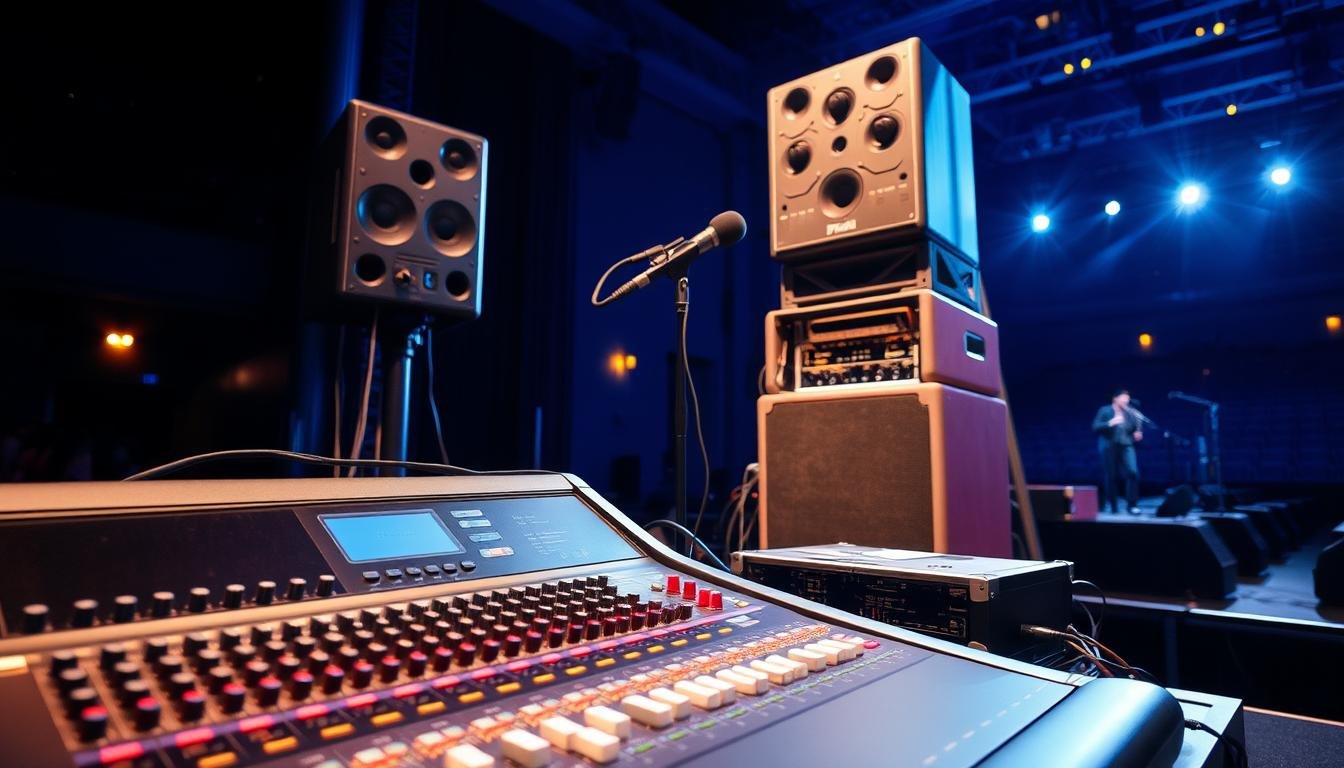

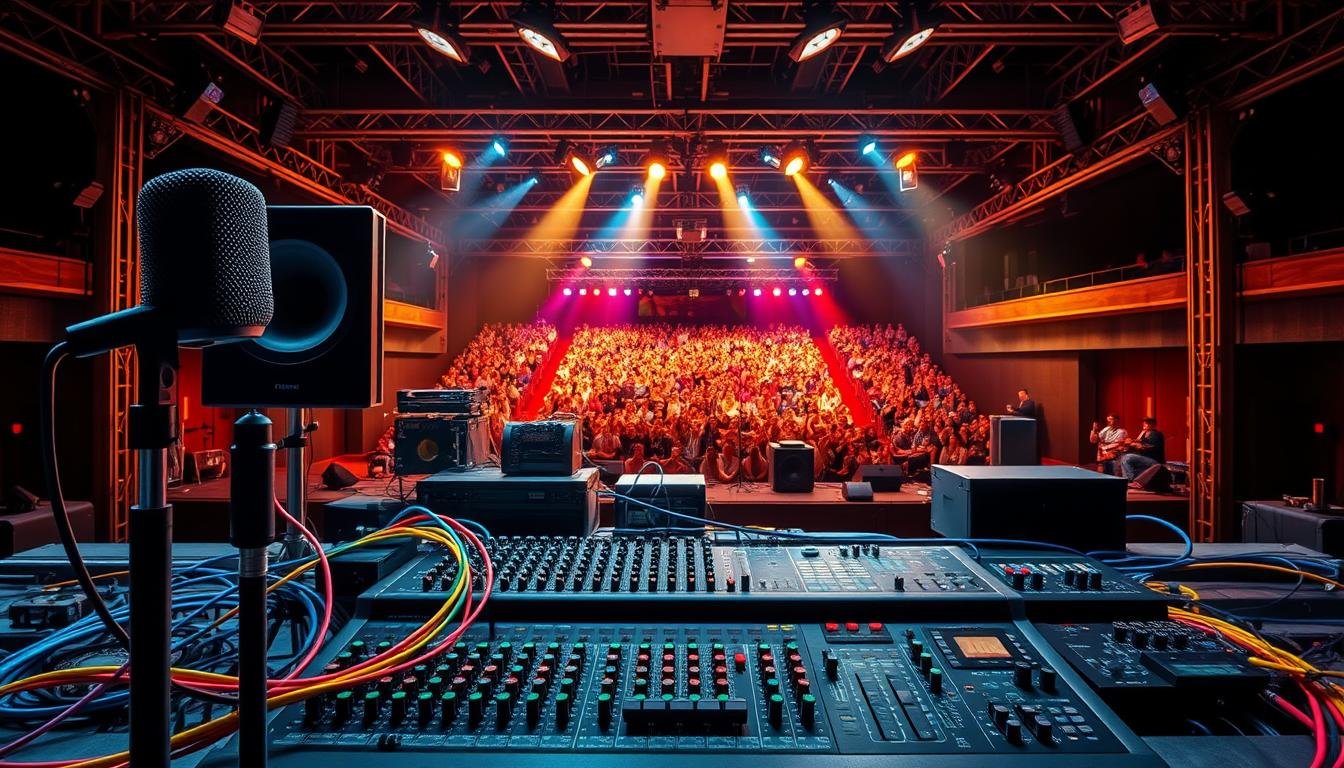
Live sound engineering is key to making events unforgettable. This includes concerts, festivals, corporate events, and weddings.
The art of sound reinforcement makes sure everyone hears the audio clearly. This is true no matter where they sit in the venue.

Knowing the live sound basics is vital for those in the music or events world. It’s the foundation for delivering top-notch audio experiences.
Key Takeaways
- Live sound engineering is vital for successful events.
- Sound reinforcement ensures quality audio for all attendees.
- Understanding live sound basics is crucial for industry professionals.
- Clear and balanced audio enhances the overall event experience.
- Proper sound reinforcement requires careful planning and execution.
Introduction to Live Sound: Understanding the Basics
Live sound engineering is a mix of technical skills and creative thinking. It makes live shows come alive. You need to know a lot about sound and how to enhance performances.
What is Live Sound Engineering?
Live sound engineering makes sure the audio at events like concerts is top-notch. It involves setting up sound gear, doing sound checks, and adjusting things during the show.
Key aspects of live sound engineering include:
- Understanding the venue’s acoustics and how they impact the sound
- Selecting and setting up appropriate sound equipment
- Conducting thorough sound checks before the event
- Making real-time adjustments during the performance
The Science and Art of Sound Reinforcement
Sound reinforcement is key in live sound engineering. It boosts the natural sound of performers so everyone can hear it well. It’s a mix of science and art.
The science part is about how sound waves work and how to use gear like equalizers and compressors. The art side is about making choices on how to mix levels and place microphones.
Some key considerations in sound reinforcement include:
- Microphone selection and placement
- Adjusting EQ to compensate for the venue’s acoustics
- Using compression to control dynamic range
By blending technical skills with artistic insight, live sound engineers create great experiences for the audience.
Essential Live Sound Equipment
Live sound equipment is vital for any audio event. Knowing the essentials is crucial. A good live sound system ensures high-quality audio that engages the audience.
Microphones and Their Applications
Microphones are key in live sound systems. They capture sound and turn it into an electrical signal. The right microphone depends on the performance, venue, and sound quality needed.
Dynamic vs. Condenser Microphones
Dynamic microphones are strong and versatile. They’re great for loud instruments and vocals. Condenser microphones are more sensitive and capture nuanced sounds. A top audio engineer says,
“The right microphone can make or break a performance. It’s all about understanding the strengths and weaknesses of each type.”
Wireless Systems
Wireless microphones give performers freedom to move. They can enhance the performance and audience experience. But, they need careful management to avoid interference.
Mixing Consoles
The mixing console is the heart of a live sound system. It mixes, processes, and routes audio signals. A good console offers controls and flexibility for the desired sound. Modern consoles have digital signal processing for various effects.
Key features to look for in a mixing console include:
- Number of channels and flexibility in routing
- Quality of preamps and signal processing
- Built-in effects and processing capabilities
- User interface and ease of operation
Amplifiers and Speaker Systems
Amplifiers and speakers are vital for delivering audio to the audience. Amplifiers boost the signal from the mixing console. Speakers, like main PA speakers and monitors, serve specific roles in the sound system.
The quality of amplifiers and speakers greatly affects sound quality. It’s important to invest in high-quality components for the venue and event.
Signal Flow in Live Sound Systems
The journey of sound from its source to the audience is complex. It’s called signal flow. Knowing this process is key to high-quality sound in live shows.
Input Stage: From Source to Console
The sound journey starts at the input stage. Here, sound is captured from sources like microphones, instruments, or pre-recorded tracks. The quality of this stage greatly affects the sound.
Key Components of the Input Stage:
- Microphones: Choosing the right type and positioning them correctly.
- Instruments: Direct input or miking instruments for optimal sound capture.
- Pre-recorded Tracks: Integrating playback tracks into the live sound mix.
Processing Stage: EQ, Compression, and Effects
After capturing sound, it moves to the processing stage. Here, the sound is enhanced and adjusted with various tools.
EQ (Equalization) balances the sound’s frequency response. It makes the sound more natural or enhances specific characteristics.
Compression reduces the sound’s dynamic range. This ensures loud signals are not too loud and quiet signals are not too soft, for a consistent sound.
| Processing Tool | Purpose | Common Applications |
|---|---|---|
| EQ | Balance frequency response | Correcting tonal imbalances, enhancing specific frequencies |
| Compression | Reduce dynamic range | Vocal leveling, controlling loud instruments |
| Effects Processors | Add ambiance or alter sound | Reverb, delay, distortion for creative effects |

Output Stage: Amplification and Speaker Distribution
The final stage is the output stage. Here, the sound is amplified and sent to the audience through speakers. The quality and placement of speakers are crucial for clear and even sound distribution.
Key Considerations for the Output Stage:
- Amplifier Power: Ensuring sufficient power to drive the speakers.
- Speaker Placement: Positioning speakers for optimal sound distribution.
- Sound Checking: Testing the system to ensure it is working correctly.
By managing signal flow well, live sound engineers can greatly improve live performances. This ensures a great experience for both performers and the audience.
Setting Up a Basic Live Sound System
Creating a great live sound experience starts with careful planning. Before the event, setting up your sound system is key. This ensures top-notch audio for your audience.
Pre-Event Planning and Preparation
Planning before the event is vital for a successful sound setup. You need to know the venue, the event type, and how many will attend. Venue analysis helps spot acoustic issues and find the best spots for speakers and mics.
Make a detailed list of equipment needed for the event. This should include mics, mixers, amps, and speakers. Make sure everything works and you have the right cables and adapters.
Equipment Placement and Connection
Where you place your equipment greatly affects sound quality. This means setting up the stage and placing FOH gear.
Stage Setup
When setting up the stage, think about mic, monitor, and instrument placement. Microphone placement should avoid feedback and capture sound well. Monitors should face the performers for clear audio.
Front of House Positioning
The FOH spot is key for sound quality control. The mixing console should offer a clear view of the stage and audience. Speakers should aim sound at the audience, avoiding reflections.
| Equipment | Purpose | Considerations |
|---|---|---|
| Microphones | Capture sound from performers | Type, placement, and number |
| Mixing Console | Mix and balance audio signals | Number of channels, features (e.g., EQ, compression) |
| Speakers | Amplify sound to the audience | Power, size, and placement |
System Testing and Troubleshooting
After setup, test the system thoroughly. Check each part, from mics to speakers, and adjust as needed.
Fixing common issues like feedback, distortion, or sound problems is crucial. Knowing how to quickly solve these can save time and ensure a smooth event.
Sound Check and Mixing Techniques
Getting a live sound just right is all about careful sound checking and mixing. A good sound check makes sure the audio fits the venue and the show. Mixing techniques then bring the event to life.
Conducting an Effective Sound Check
A solid sound check is key to a great live event. It means checking each part of the sound system to make sure it’s working. Start by testing each microphone to see if it’s working right and at the right level.
It’s also important to test the monitoring system. Make sure the performers can hear themselves well through their monitors. This helps them perform better and avoid straining their voices.
Basic Mixing Principles
Mixing is an art that needs a good ear and some technical knowledge. Two main mixing principles are gain structure and EQ.
Gain Structure
Gain structure is about managing signal levels in the sound system. It’s important to keep the signal strong enough to be heard but not so strong it distorts. Aim for signal peaks around -6 dB.
EQ and Frequency Management
EQ, or equalization, helps adjust the tone of the audio signal. Good EQ techniques can make the sound clearer and better. It’s key to manage frequencies to avoid sound clashes.
| Frequency Range | Effect | Application |
|---|---|---|
| Low Frequencies (20 Hz – 200 Hz) | Adds warmth and depth | Bass instruments, kick drum |
| Mid Frequencies (200 Hz – 2000 Hz) | Affects body and clarity | Vocals, guitars, keyboards |
| High Frequencies (2000 Hz – 20000 Hz) | Adds brightness and clarity | Cymbals, high-hat, vocals |
Managing Feedback and Common Issues
Feedback is a big problem in live sound. It happens when sound from speakers gets picked up by microphones and amplified again. To avoid feedback, position microphones carefully and adjust their gain levels. Tools to suppress feedback can also help.
Other issues like distortion and hum can also happen. Distortion comes from too high gain levels, and hum is often from electrical interference. Regular checks on the sound system and cables can prevent these problems.

Understanding Acoustics in Live Venues
The sound quality in live venues is crucial for both performers and the audience. Knowing how to improve this quality is key.
Room Acoustics Fundamentals
Room acoustics studies how sound acts in closed spaces. It looks at how sound waves interact with the environment. This includes reflections, absorption, and diffusion.
The size, shape, and materials of a venue affect its sound. Each venue has its own unique sound.
Key Factors in Room Acoustics:
- Reverberation time: The time it takes for sound to fade away.
- Sound reflections: How sound bounces off surfaces.
- Absorption: How materials soak up sound energy.
- Diffusion: How sound spreads out in different directions.
Dealing with Challenging Acoustic Environments
Some venues are harder to work with than others. Venues with hard surfaces and high ceilings can have too much echo. Very large venues need a lot of sound reinforcement.
Strategies for challenging environments include:
- Using acoustic treatment to control echo.
- Positioning speakers and microphones to avoid feedback.
- Adjusting the sound system to match the venue’s acoustics.
Acoustic Treatment Solutions
Acoustic treatment uses special materials and designs to enhance sound quality. It includes absorption panels to reduce echo, diffusion elements to scatter sound, and bass traps to manage low frequencies.
| Acoustic Treatment | Purpose | Examples |
|---|---|---|
| Absorption Panels | Reduce echo and control mid-to-high frequencies. | Auralex Acoustics Panels, Owens Corning 703 |
| Diffusion Elements | Scatter sound for better spatial impression and less echo. | Quadratic Residue Diffusers, Primitive Root Diffusers |
| Bass Traps | Manage low frequencies to reduce boominess. | Helmholtz Resonators, Broadband Absorption Panels |
Sound engineers can greatly improve sound quality by understanding and addressing venue acoustics. Whether through treatment or sound system adjustments, the goal is to ensure clear sound for everyone.
Digital vs. Analog Live Sound Systems
The world of live sound is split into two main technologies: digital and analog systems. Each has its own strengths. The choice between them depends on the event type, venue, and sound quality desired.
Digital live sound systems are popular for their flexibility and precision. One key advantage is their ability to store and recall settings. This makes managing complex sound setups easier, perfect for large events.
Advantages and Disadvantages of Digital Systems
Digital systems have many benefits:
- Flexibility in signal processing and routing
- Ability to store and recall settings
- Compact design, saving space
But, they also have some downsides:
- Potential for latency issues
- Dependence on software and hardware compatibility
- Steep learning curve for complex systems
Analog live sound systems are loved for their warm and natural sound. Analog systems are favored by audio purists for their unique sonic qualities.
Advantages and Disadvantages of Analog Systems
Analog systems have several advantages:
- Warm and natural sound quality
- Simpler operation and maintenance
- No latency issues
But, they also have some limitations:
- Limited flexibility in signal routing and processing
- More physical space required for equipment
- Settings cannot be stored or recalled easily

Hybrid Approaches for Different Scenarios
Often, a hybrid approach that combines digital and analog systems works best. For instance, using digital consoles for their flexibility and recall, while keeping analog outboard equipment for specific tasks. This mix allows sound engineers to get the best sound quality.
The choice between digital, analog, or hybrid systems depends on the event’s needs and the sound engineer’s preferences. Knowing the pros and cons of each helps professionals make the right choice for the best audio experience.
Live Sound for Different Applications
Live sound technology is used in many places, from concerts to conferences. It’s flexible and meets different needs. Each setting has its own challenges and requirements.
Music Performances and Concerts
Concerts need top-notch sound quality. The system must handle loud sounds well and keep audio clear. Choosing the right microphones and setting up the mixing console right are key.
Conferences and Public Speaking
At conferences, clear sound is essential. The system should cover the whole area well. This way, everyone can hear the speaker clearly. Speech reinforcement systems help make the speaker’s voice loud and clear.
Houses of Worship
Houses of worship face a special challenge. They need systems that work for both sermons and music. The system must handle different sounds well and sound balanced everywhere.
Outdoor Events and Festivals
Outdoor events face weather and noise issues. Live sound systems for these events must be strong and weather-proof. Using windshields on microphones and picking the right speakers can help.
In summary, live sound technology is very flexible. It can meet the needs of many different situations. Sound engineers can make sure the audio is top-notch by understanding each setting’s needs.
Conclusion
Learning about live sound basics is key for top-notch sound at events. This includes music shows, conferences, and speeches.
Knowing the basics of live sound engineering helps a lot. It covers essential gear, signal flow, and acoustics. This knowledge lets you set up and run a live sound system well.
Sound reinforcement is more than just making sound louder. It’s about making the experience for the audience better. With what you’ve learned, you’ll handle live sound situations with ease.
Being good at live sound engineering takes careful planning and attention to detail. It also means being ready to adjust to new situations and places.
FAQ
What is the difference between dynamic and condenser microphones?
Dynamic microphones are tough and great for loud sounds like drums. Condenser microphones are more sensitive. They’re perfect for capturing detailed sounds from instruments and vocals.
How do I prevent feedback during a live sound event?
To stop feedback, make sure microphones are placed right. Also, keep monitor speakers away from mics. Adjust EQ settings to cut out feedback-prone frequencies.
What is the role of a mixing console in live sound?
A mixing console blends audio signals from different sources. It adjusts levels, tone, and more to create a clear mix for the audience.
What are the benefits of using digital live sound systems?
Digital systems are flexible and easy to use. They let you recall settings, making them great for complex events and frequent shows.
How do I choose the right amplifier and speaker system for my live sound needs?
Pick an amplifier and speaker based on the venue size, performance type, and sound quality needed. Make sure it can handle the power and frequency range required.
What is the importance of gain structure in live sound mixing?
Good gain structure is key for a clean mix. It ensures the signal is optimized at each stage, from input to output.
How can I improve the acoustics in a challenging live venue?
Use acoustic treatment like absorption panels and diffusion. Also, place speakers strategically to cut down echo and reverberation.
What are the key considerations for setting up a live sound system for outdoor events?
For outdoor events, think about weather protection and power supply. Also, consider background noise. Make sure the system is strong and can adapt to the outdoor setting.