
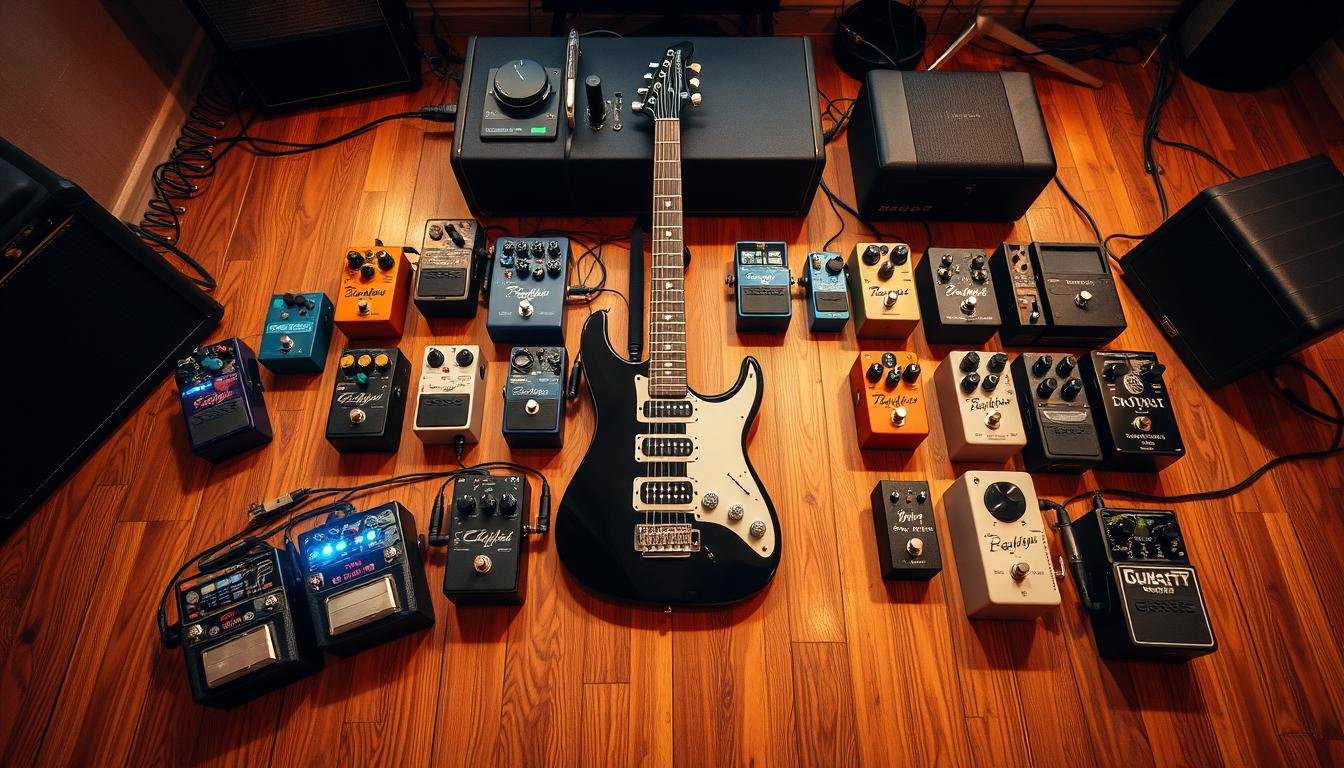
A well-crafted pedalboard is more than just a collection of effects. It’s an ecosystem where each stompbox plays a vital role in shaping your sound.
This guide on guitar pedal order explained will help you navigate the complexities of pedal placement.
Guitar Pedal Order Explained: Understanding the Basics
From the lush ambiance of reverb to the gritty texture of fuzz, the interaction between multiple pedals and their order significantly impacts your overall tone.
Understanding how to optimize your pedal chain is crucial for achieving the desired sound.
Key Takeaways
- Understanding the role of each effects pedal is crucial for tone shaping.
- The order of pedals in your chain affects your overall sound.
- Optimizing your pedal chain can help achieve the desired tone.
- A well-crafted pedalboard is an ecosystem of effects.
- Experimenting with different pedal orders can lead to new sounds.
Understanding Guitar Pedals: An Overview
To grasp the role of guitar pedals, it’s key to know what they are and how they function. These electronic devices change a guitar’s sound by processing the audio signal. They modify it in many ways.
What Are Guitar Pedals?
Guitar pedals, also known as effects pedals, change a guitar’s sound. They come in many types, each for a specific effect. This includes distortion, delay, or reverb.
Some common types of guitar pedals include:
- Distortion pedals, which add a gritty, overdriven sound to the guitar.
- Delay pedals, which repeat the guitar signal, creating an echo effect.
- Reverb pedals, which simulate the ambiance of different environments.
How Do Guitar Pedals Work?
Guitar pedals intercept the guitar signal and modify it before it hits the amplifier. The process is simple:
- The guitar signal goes to the pedal.
- The pedal changes the signal, like adding distortion or delay.
- The new signal then goes to the amplifier.
The order of pedals matters a lot, known as effects pedal placement. Knowing guitar pedal signal flow helps get the right tone.
Understanding guitar pedals and how they work opens up new sounds for musicians. It lets them enhance their sound and express themselves more in music.
The Importance of Pedal Order
A well-planned pedalboard signal chain is key to better sound quality. The order of your guitar pedals greatly affects your tone and sound quality.
Setting up your pedalboard requires understanding that pedal order is not random. The right order can boost or ruin your sound, depending on how you arrange it.
Why Pedal Order Matters
The order of your pedals shapes how your signal is processed. For example, putting a distortion pedal before a delay pedal changes the sound. This is because the distortion affects the signal before the delay, making the delayed sound more distorted.
Trying out different pedal orders can reveal new tones and effects. Knowing how to arrange your pedals is crucial for getting the sound you want.
Common Issues with Incorrect Order
Wrong pedal order can cause noise, signal loss, and a muddled sound. For instance, putting a noise gate after a distortion pedal might not work well. This is because the distorted signal might trigger the gate too much.
To show how pedal order affects sound, here’s a table comparing different orders and their effects:
| Pedal Order | Effect on Sound |
|---|---|
| Distortion > Delay | Produces a heavily distorted delayed sound |
| Delay > Distortion | Results in a delayed sound that is then distorted, creating a more textured effect |
| Compressor > Distortion | Evenly compresses the signal before distortion, leading to a more controlled sound |

Understanding the importance of how to arrange guitar pedals lets you control your sound. Try different setups and know each pedal’s role for the best sound quality.
Standard Pedal Order Sequence
Guitarists often argue about the best order for their effects pedals. But, a standard sequence can be a good starting point. It’s not perfect for everyone but helps in experimenting.
Basic Pedal Chain Setup
A common pedal order starts with tuners, then filters and dynamics, gain-based pedals, modulation effects, and lastly, time-based effects. This order makes sense because it changes the signal in a logical way.
The tuners are first because they need a clean signal. Next, filters and dynamics like wah-wah and compressors adjust the signal’s dynamics and tone.
Examples of Standard Orders
Here’s a common pedal order: Tuner -> Wah -> Compressor -> Overdrive/Distortion -> Modulation (Chorus, Flanger, etc.) -> Delay -> Reverb. Many guitarists start here.
For example, a guitarist might use a tuner, then a wah pedal for dynamic tone changes. Next, a compressor evens out the signal. Overdrive or distortion adds gain, followed by modulation effects for texture. Delay and reverb add space and depth.
- Tuner: Ensures the guitar is in tune.
- Wah: Adds expressive, dynamic tone changes.
- Compressor: Evens out the signal for a consistent volume.
- Overdrive/Distortion: Adds gain for a heavier sound.
- Modulation: Includes effects like chorus and flanger for added texture.
- Delay: Creates echoes of the signal.
- Reverb: Adds ambiance and depth to the sound.
Knowing and using a standard pedal order can really improve a guitarist’s sound. By starting with a basic setup and trying different orders, guitarists can find the perfect sound for their music.
Types of Guitar Effects Pedals
Guitarists have many effects pedals to choose from, each with its own purpose. These pedals let musicians try out different sounds and styles. This helps them create their unique sound.
Distortion and Overdrive
Distortion and overdrive pedals are favorites among guitarists. They make the guitar sound gritty and fuzzy. Distortion pedals are great for heavy metal and hard rock. On the other hand, overdrive pedals are perfect for blues and rock, offering a softer distortion.
Modulation Effects
Modulation effects pedals add depth and texture to the guitar sound. They include chorus, flanger, and phaser pedals. For example, a chorus pedal can make one guitar sound like many. This adds width to the sound.
Delay and Reverb
Delay and reverb pedals create space in the sound. Delay pedals repeat the sound after a while. Reverb pedals make it sound like the guitar is in a big space, like a hall.

| Type of Pedal | Function | Typical Use |
|---|---|---|
| Distortion | Adds a gritty, fuzzy quality | Heavy metal, hard rock |
| Overdrive | Provides a softer distortion | Blues, rock |
| Chorus | Creates a wider sound | Rock, pop |
| Delay | Repeats the sound | Ambient, experimental |
| Reverb | Simulates natural ambiance | Various genres |
The Role of the Guitar and Amp in Pedal Order
To get the best sound, think about how your guitar and amp affect the signal flow. These are key parts of the chain, shaping the tone and how pedals work with it.
Signal Flow Basics
The signal flow is the path sound takes from your guitar to the amp. Knowing this path is key to setting up your pedals right. It starts with the guitar, where pickups turn string vibrations into an electrical signal.
The type of pickups used can significantly affect the tone. Single-coil pickups give a bright sound, while humbuckers are warmer. The signal then goes through pedals, changing the tone, before hitting the amp.
How Guitar Pickups Affect Sound
Pickups are crucial in setting the tone that pedals and the amp will modify. Each type of pickup has its own sound. Knowing these can help pick the right pedals and settings for your sound.
| Pickup Type | Tonal Characteristics | Best Used With |
|---|---|---|
| Single-Coil | Bright, articulate, prone to hum | Clean tones, bright reverb |
| Humbucker | Full, warm, hum-reducing | High-gain distortion, heavy metal |
| Active | High output, clear, requires battery | High-gain settings, metal, jazz |
Choosing the right pickups is a personal choice. It depends on your music style and what sound you like. Trying out different pickups can really improve your sound.
Experimenting with Pedal Order
Playing around with your guitar pedal order can lead to new sounds. Guitarists often find that changing their pedal order can really improve their tone. It can also open up new creative possibilities.
Whether you want to add grit to your clean tones or make your high-gain sounds smoother, the order matters. How you arrange your pedals can make a big difference.
Rearranging for Unique Sounds
To get unique sounds, try rearranging your pedals. For example, putting a distortion pedal before a delay can make your sound heavily distorted. But reversing this order can give you a cleaner delay effect.
Experimenting with different configurations can help you find the perfect tone for your music.
- Start by changing the order of your distortion and modulation pedals to see how it affects your sound.
- Try placing your reverb pedal at the end of your chain for a more natural ambiance.
- Experiment with different pedal combinations to find what works best for your style.
Effects of Placement on Tone
The placement of your pedals can greatly change your tone. For instance, putting a wah pedal before a distortion can make your sound more dynamic. But putting it after can make it more subtle.
Understanding how different placements affect your tone is crucial. It helps you master your guitar’s sound.
As guitar legend “The way you arrange your pedals can either make or break your tone.” This shows how important it is to experiment and understand how each pedal works in your signal chain.
“The order of operations in your effects chain can drastically change the character of your sound.”
By adjusting your pedal order and understanding the effects of different placements, you can tailor your sound. This way, it will perfectly match your musical needs.
The Influence of Musical Genre on Pedal Order
Genre-specific guitar pedal setups are key to getting the right sound for different musical styles. The order and type of pedals change with each genre. This is because each style has its own unique sound needs.
Different genres use different tones, making it important to know the right pedal setup. Whether you play rock, metal, jazz, or blues, the right pedal order is crucial for your sound.
Rock and Metal Pedal Setups
Rock and metal music often start with a distortion or overdrive pedal. Then comes a compressor to control the sound’s dynamics and sustain it. A typical setup is: guitar – tuner – overdrive/distortion – compressor – EQ – modulation effects (like chorus or flanger) – delay – reverb – amp.
Metal music needs a high-gain distortion pedal for its aggressive tone. Noise gates are also used to manage high-gain noise.
Jazz and Blues Considerations
Jazz and blues musicians aim for a clean, nuanced sound. Jazz often starts with a tuner, then a compressor to balance dynamics. Modulation effects like chorus or reverb are added for depth. Overdrive pedals are less common but can add warmth.
Blues guitarists use overdrive and distortion pedals for that gritty, emotive sound. The order can vary, but a wah-wahpedal is often used for expressive playing.
Knowing these genre-specific needs helps musicians tailor their pedal order. This way, they can achieve the desired tone and improve their overall sound.
Advanced Pedal Order Techniques
Advanced pedal order techniques can really boost your sound versatility. By using smart methods in your pedal chain guide, you can explore more tones.
One key technique is splitting your signal. This lets you make different paths for your sound. It’s great for making complex, layered sounds.
Splitting Your Signal
Splitting your signal means dividing your guitar’s sound into two or more paths. You can do this with a signal splitter or your amplifier’s effects loop.
Benefits of Signal Splitting:
- Allows for parallel processing of different effects
- Enhances tonal complexity
- Provides greater flexibility in sound shaping
| Signal Splitting Method | Description | Tonal Outcome |
|---|---|---|
| Parallel Processing | Divides signal into two paths for separate effects processing | Complex, layered tone |
| Effects Loop Utilization | Uses amplifier’s effects loop to send signal to external pedals | Enhanced dynamics and texture |
Using Loops and Switchers
Loops and switchers are advanced tools for managing your pedalboard signal chain. They let you control your effects order and switch between setups quickly.
With loops and switchers, you can:
- Easily switch between different pedal configurations
- Create complex effect chains
- Enhance your overall performance flexibility
In conclusion, techniques like signal splitting and using loops and switchers can really improve your sound. By mastering these methods, you can elevate your music to new levels.
Troubleshooting Common Issues with Pedal Order
Fixing your pedal order is key to getting rid of unwanted noise and better sound. Guitarists often face problems with their effects pedals because of how they’re arranged.
Having a good plan for your effects pedal order can really change your tone. Noise, interference, and sound quality issues can often be fixed by changing the order of your pedals.
Noise and Interference
Noise and interference are common problems for guitarists with effects pedals. The order of your pedals can cause a lot of noise. For example, putting a high-gain distortion pedal first can add a lot of noise.
To cut down on noise, put your noise reduction pedals in the right spot. They work best after high-gain pedals but before modulation effects.
Sound Quality Problems
Sound quality issues can come from many places, like the pedals you use and where you put them. For instance, overdrive and distortion pedals can change your tone a lot, depending on where they are in the chain.
To get the best sound, try these tips:
- Put your EQ pedal after your gain pedals to tweak your tone.
- Use your compressor pedal early to control the volume.
- Try different spots for your modulation, delay, and reverb pedals to find the right ambiance.
Understanding how different pedals work together can help you make your sound better.
Final Thoughts on Guitar Pedal Order
Learning about pedal order is a journey that makes your sound better and opens up new creative paths. By understanding how guitar pedals work, you can explore many different tones. This improves your music-making skills.
Tone Enhancement Strategies
Try out different pedal orders to find the best sound for you. This way, you can create unique tones for different music styles. Think about how to arrange your pedals to get the sound you want, like adding distortion or ambiance.
Exploring New Sounds
Keep trying new pedal orders to find your unique sound. This is where the real creativity happens. By experimenting and refining your setup, you can make your music stand out and grow as an artist.
FAQ
What is the best order for guitar pedals?
The best order for guitar pedals starts with dynamics and filters. Then comes gain-based pedals like overdrive and distortion. Next are modulation effects, and lastly, time-based effects like delay and reverb.
How do I determine the correct pedal order for my sound?
Start with a basic setup and try different pedal orders. Listen to how each pedal affects the others. Adjust the order to get the sound you want.
What is the difference between a pedal chain and a signal chain?
A pedal chain and a signal chain mean the same thing. They’re the order your guitar signal goes through effects pedals, from guitar to amp.
Can the type of guitar or amplifier affect the optimal pedal order?
Yes, the type of guitar and amplifier can change the best pedal order. Different pickups and amps affect how pedals sound.
How do I reduce noise when using multiple guitar pedals?
Use a noise gate pedal to reduce noise. Make sure your pedals are well-powered. Rearrange your pedals to cut down on noise buildup.
Are there specific pedal orders recommended for different genres of music?
Yes, each genre has its own pedal order. For example, metal uses heavy distortion and gain. Jazz uses overdrive and modulation.
What is signal splitting, and how can it be used in pedal order?
Signal splitting divides your guitar signal into paths. This lets you create complex tones by using different pedals or effects chains.
How can I troubleshoot issues with my pedalboard?
Check your cables and connections first. Make sure your pedals are powered right. Test each pedal to find the problem.
Can using a loop or switcher improve my pedal order?
Yes, a loop or switcher can help. They let you switch between effects easily. This makes your setup simpler and more flexible.
How often should I experiment with my pedal order?
Experiment with your pedal order whenever you want to change your sound. The best order can change based on your music and personal taste.