
Creating music needs the right tool. Musicians and producers often choose between digital piano vs MIDI controllers. Each has its own role and benefits.
Choosing the right instrument can be tough, even for beginners. This article will help you understand the differences between digital pianos and MIDI controllers. It will guide you to pick the best one for you.
Key Takeaways
- Understand the primary functions of digital pianos and MIDI controllers.
- Learn about the key features to consider when choosing an instrument.
- Discover the benefits of using a digital piano for music production.
- Explore the advantages of MIDI controllers in music creation.
- Determine the best instrument for your specific needs and goals.
Understanding Digital Pianos: Features and Functionality
Digital pianos have many cool features to improve your playing. They aim to feel and sound like real pianos. They also have extra features to make practicing and playing more fun.
Key Action and Touch Response
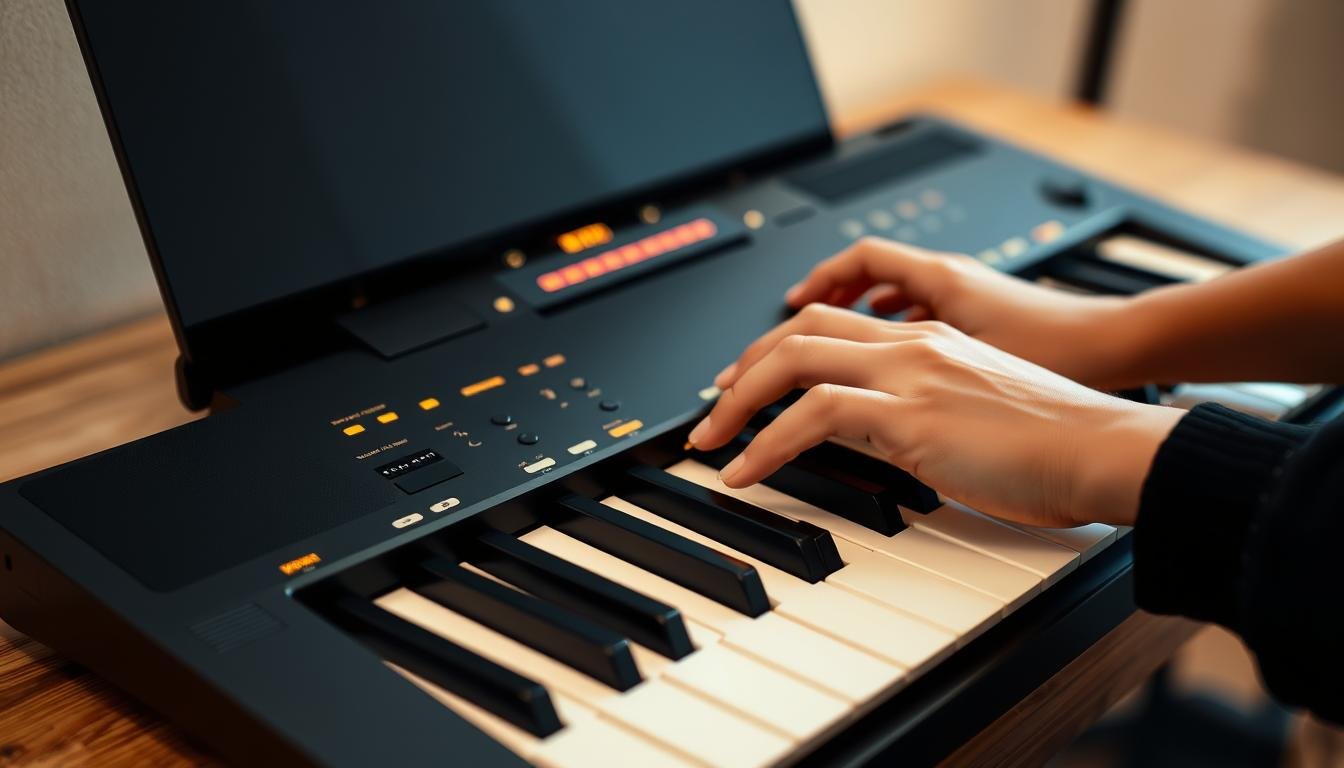
The key action and touch response are key in digital pianos. The key action is the part under the keys that feels like a real piano. Good digital pianos have weighted keys or hammer action to feel just right.
Touch response changes the sound based on how hard you press the keys. This lets you play with more feeling and control.
Built-in Sounds and Sound Engine
Digital pianos have lots of built-in sounds. They use a sound engine to make these sounds. The sound engine is the heart of the piano, making the sounds sound real.
Today’s digital pianos have many sounds, from different pianos to other instruments. This lets you play in many ways.
Integrated Speakers and Amplification
Digital pianos also have integrated speakers and amplification. These are key for hearing the sound well. Good digital pianos have strong speakers for clear sound at any volume.
This makes them great for practicing and small shows.
In short, digital pianos offer a full musical experience. They have realistic key action, lots of sounds, and great speakers. Knowing these features helps musicians pick the right digital piano for them.
Exploring MIDI Controllers: Capabilities and Design
MIDI controllers are key in today’s music making. They connect the musician or producer to their digital audio workstation (DAW). This lets them make complex music. With many types of MIDI controllers out there, picking the right one can be hard.
Types of MIDI Controllers
MIDI controllers vary to meet different needs. Here are some common types:
- Keyboard Controllers: These look like regular keyboards and are great for pianists and composers.
- Pad Controllers: With a grid of pads, they’re perfect for triggering samples and beats.
- Control Surface Controllers: They have knobs, sliders, and buttons for tweaking DAW settings.
Connectivity Options and Compatibility
Knowing how MIDI controllers connect is key for a smooth setup. Most use USB or MIDI ports.
Comparison of Connectivity Options:
| Connectivity Type | Advantages | Disadvantages |
|---|---|---|
| USB | Easy to connect, widely supported | Limited cable length |
| MIDI | Flexible, works with older systems | Needs a separate MIDI interface |
| Wireless | Convenient, cuts down on clutter | May have interference, latency |
Additional Control Features
Many MIDI controllers have extra features. These include assignable controls, velocity sensitivity, and aftertouch. These features make the controller more expressive and flexible.

Digital Piano vs MIDI Controller: Which One Should You Buy?
Choosing between a digital piano and a MIDI controller requires understanding their main differences and similarities. Knowing these will help you pick the right instrument for your music needs and tastes.
Primary Differences in Functionality
Digital pianos aim to mimic playing an acoustic piano. They focus on how keys feel, sound quality, and have built-in speakers and sounds.
MIDI controllers, on the other hand, are for music making. They have controls like keys and knobs for working with digital sounds in music software.
Overlap in Features and Capabilities
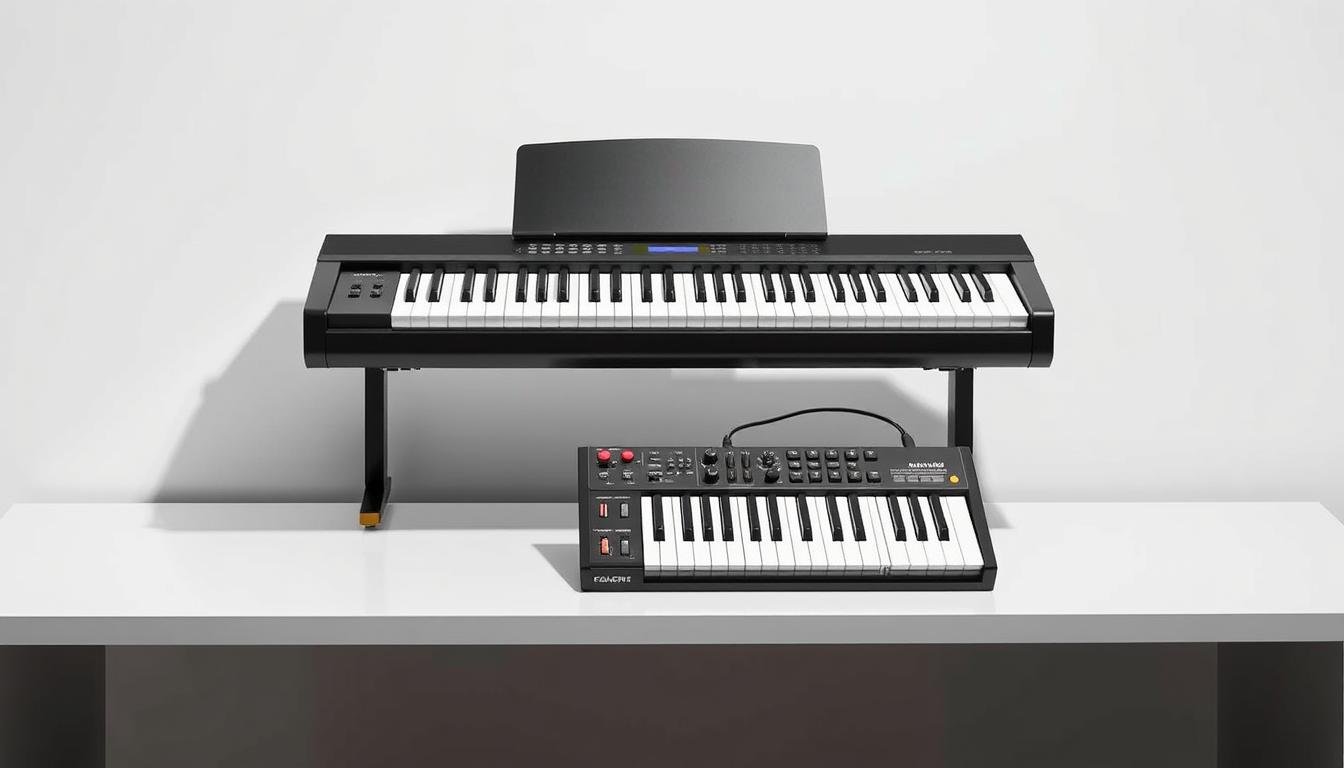
Even though they’re different, digital pianos and MIDI controllers share some features. Many digital pianos can connect via MIDI, and some MIDI controllers have piano-like features like weighted keys.
Both can be used for playing piano or making music. But, they’re set up differently for their main uses.
Determining Your Primary Needs
Think about what you want to do with your instrument. If you play piano or keyboard, a digital piano might be better. For music production or electronic music, a MIDI controller is likely a better fit.
| Feature | Digital Piano | MIDI Controller |
|---|---|---|
| Primary Function | Piano playing experience | Music production control |
| Key Action | Weighted, touch-sensitive | Varied, sometimes weighted |
| Built-in Sounds | Yes, often extensive | No, relies on external DAW |
| MIDI Connectivity | Often available | Standard feature |
By looking at your needs and what each instrument offers, you can choose the right one for your music goals.
Sound Production: Self-Contained vs Computer-Dependent
Digital pianos and MIDI controllers have different ways of making sound. Digital pianos make sound by themselves, while MIDI controllers need a computer to make sound.
How Digital Pianos Generate Sound
Digital pianos use sound engines and speakers to make sound. They have many sounds like piano, strings, and more. The sound engine turns the player’s actions into sound through speakers or headphones.
Key factors in digital piano sound production:
- Quality of the sound engine
- Sample quality of the built-in sounds
- Amplification and speaker quality
How MIDI Controllers Work with DAWs
MIDI controllers send MIDI data to a computer or DAW. The computer then makes the sound based on the MIDI data. The sound quality depends on the DAW and the virtual instruments or samples used.
The flexibility of MIDI controllers lies in their ability to control a wide range of virtual instruments and external synthesizers.
Sound Quality Considerations
Digital pianos and MIDI controllers have different sound qualities. Digital pianos are easy to use and sound consistent. MIDI controllers need more technical skill to get good sound.
| Instrument | Sound Production Method | Sound Quality Factors |
|---|---|---|
| Digital Piano | Built-in sound engine and speakers | Sound engine quality, sample quality, amplification |
| MIDI Controller | External DAW or computer | DAW quality, virtual instrument quality, user expertise |
In conclusion, choosing between a digital piano and a MIDI controller depends on your needs. Knowing how each makes sound helps you decide.
Learning Curve and Skill Development
Choosing between digital pianos and MIDI controllers depends on the learning curve and skill development. Both offer different paths to musical skill, fitting various needs and learning styles.

Transitioning from Acoustic Piano
Switching from an acoustic piano to a digital one is easier. The feel and touch are similar, making it a smoother transition. Digital pianos often have weighted keys that feel like an acoustic piano, helping keep or improve playing technique.
Pianist and educator
“The transition from acoustic to digital piano is seamless for most students, as the playing technique remains largely the same.”
This continuity is key for those who have spent years honing their skills on an acoustic piano.
Music Production Learning Path
MIDI controllers need a different set of skills for music production. Understanding MIDI protocol, DAW integration, and virtual instrument manipulation are crucial. These skills are needed to produce music with a MIDI controller.
- Learning to navigate a DAW (Digital Audio Workstation)
- Understanding MIDI mapping and control
- Experimenting with different virtual instruments and effects
The learning curve for MIDI controllers is steeper. It requires understanding music production software and techniques. Yet, it also opens up a wide range of creative possibilities.
Versatility in Musical Styles
Digital pianos and MIDI controllers both allow for exploring various musical styles. Digital pianos have built-in soundsand rhythms for different genres. MIDI controllers, with their control over virtual instruments, offer even more flexibility. They enable producers to create a wide range of musical styles, from electronic dance music to orchestral compositions.
| Instrument | Musical Style Versatility |
|---|---|
| Digital Piano | Built-in sounds and rhythms for various genres |
| MIDI Controller | Control over virtual instruments for diverse styles |
In conclusion, the learning curve and skill development for digital pianos and MIDI controllers are different. Digital pianos offer a familiar path for those with an acoustic piano background. MIDI controllers open up a new world in music production, each with its own learning path and creative possibilities.
Price Comparison and Value Proposition
Digital pianos and MIDI controllers come in a wide range of prices. This reflects their quality, features, and brand reputation. Knowing what you get at each price point is key to making a smart choice.
Entry-Level Options
For beginners or those watching their budget, entry-level digital pianos and MIDI controllers are a good start. They have basic features and functionality.
Key Features: They have limited polyphony, basic sounds, and few control options.
Price Range: Expect to pay between $100 and $500.
Mid-Range Instruments
Mid-range options strike a balance between cost and quality. They offer more advanced features and better sound.
Key Features: They have better polyphony, more sound options, and extra control features.
Price Range: Prices range from $500 to $1,500.
Professional-Grade Equipment
For serious musicians and producers, professional-grade digital pianos and MIDI controllers are the top choice. They have high-end features, superior sound, and advanced functionality.
Key Features: They offer high polyphony, extensive sound options, advanced controls, and are built to last.
| Category | Price Range | Key Features |
|---|---|---|
| Entry-Level | $100-$500 | Limited polyphony, basic sound options |
| Mid-Range | $500-$1,500 | Improved polyphony, expanded sound options |
| Professional-Grade | $1,500-$3,000+ | High polyphony, extensive sound options, advanced controls |
In conclusion, the price and value of digital pianos and MIDI controllers vary by category and use. By understanding the features and quality at different price points, buyers can make informed choices that fit their needs and budget.
Portability and Space Requirements
For musicians with limited space or those who travel a lot, knowing about digital pianos and MIDI controllers is key. These factors are crucial for portability and space needs.
Digital pianos look like acoustic pianos but are bigger and heavier. They can weigh from 70 to over 300 pounds. MIDI controllers, on the other hand, are smaller and lighter. Some can even fit in a backpack.
Size and Weight Considerations
The size and weight of an instrument matter a lot for moving it around. Digital pianos are bigger and heavier, making them hard to move. MIDI controllers, designed for easy transport, are smaller and lighter.
| Instrument Type | Average Weight | Average Size |
|---|---|---|
| Digital Piano | 100-300 pounds | 58″ wide, 18″ deep |
| MIDI Controller | 5-20 pounds | 20″ wide, 10″ deep |
Music production expert
“The portability of MIDI controllers makes them ideal for musicians who are always on the move.”
This shows why size and weight are important when choosing between a digital piano and a MIDI controller.
Setup Complexity and Additional Equipment
Setup complexity and the need for extra gear are also key. Digital pianos are easy to set up, needing little to no effort. MIDI controllers, though, require connection to a computer or other devices, adding to the setup hassle.
When picking between a digital piano and a MIDI controller, think about their use over time. Consider how easy they are to set up and use in different places.
Popular Models and Brands Worth Considering
Looking for the right instrument? Exploring popular models is a great start. Both digital pianos and MIDI controllers offer many options. We’ll look at top picks, their features, and what others say about them.
Top Digital Piano Recommendations
Digital pianos now mimic acoustic pianos well. Top brands include Yamaha, Kawai, and Roland. The Yamaha P-125 is loved for its feel and sounds. The Kawai ES110 is praised for its touch and tones.
Musician’s Friend says the Yamaha P-125 is great for all levels. Reviews like this help a lot.
“The best digital pianos offer a playing experience that’s very close to an acoustic piano, with the added benefit of volume control and headphone jacks for quiet practice.”
— Piano World
Leading MIDI Controller Options
MIDI controllers are key for music making. Brands like Akai, Novation, and Native Instruments are leaders. The Akai MPK Mini MKII is small but packed with features.
The Novation Launchkey series is great for DAWs like Ableton Live. Sound on Sound says it’s perfect for beginners.
- Akai MPK Mini MKII – Compact and feature-rich
- Novation Launchkey – Seamless DAW integration
- Native Instruments Komplete Kontrol – Professional-grade control
By looking at these popular models, you can find the best fit for you.
Conclusion
Choosing between a digital piano and a MIDI controller depends on your musical goals and budget. Think about what you want to achieve and how much you can spend. This will help you decide what’s best for you.
If you love playing piano, a digital piano might be the way to go. It’s great for practicing and playing without extra gear. But, if you’re into music production, a MIDI controller is better. It lets you create and control virtual instruments.
So, it’s all about what you need. Look at the features, how it works, and the cost. Yamaha, Korg, and Roland have many options for different budgets and needs.
By picking the right instrument, you’ll improve your music experience. It doesn’t matter if you’re new or experienced. Choosing the perfect instrument is key to your musical journey.
FAQ
What is the main difference between a digital piano and a MIDI controller?
A digital piano tries to feel like an acoustic piano. It has weighted keys and sounds. A MIDI controller is for making music on a computer. It sends data to devices.
Can I use a digital piano for music production?
Some digital pianos can send MIDI data. This lets you control virtual instruments. But they’re not made for music production.
Do I need a computer to use a MIDI controller?
Yes, you need a computer or device with a DAW. This is to make sound with the MIDI controller.
Are digital pianos more expensive than MIDI controllers?
Prices vary. But, high-end digital pianos are often pricier than MIDI controllers. Yet, you can find affordable options in both categories.
Can I connect a MIDI controller to a digital piano?
Some digital pianos can connect to MIDI controllers. But, not all do. Always check your piano’s specs.
What are some popular brands for digital pianos and MIDI controllers?
Yamaha, Kawai, and Roland are top digital piano brands. Akai, Novation, and Native Instruments are well-known for MIDI controllers.
How do I choose between a digital piano and a MIDI controller?
Think about what you need. Digital pianos are great for playing piano. MIDI controllers are better for music production.
Can I use a MIDI controller to control other devices beside a computer?
Yes, MIDI controllers can control synthesizers, drum machines, and more. They just need to be MIDI-compatible.
Are there any additional equipment requirements for digital pianos or MIDI controllers?
You might need headphones, amplifiers, or audio interfaces. These can enhance your experience with digital pianos or MIDI controllers.
What are some key features to consider when choosing a digital piano or MIDI controller?
For digital pianos, look at key action, sounds, and speakers. MIDI controllers should have good controls, connectivity, and compatibility with your gear.