
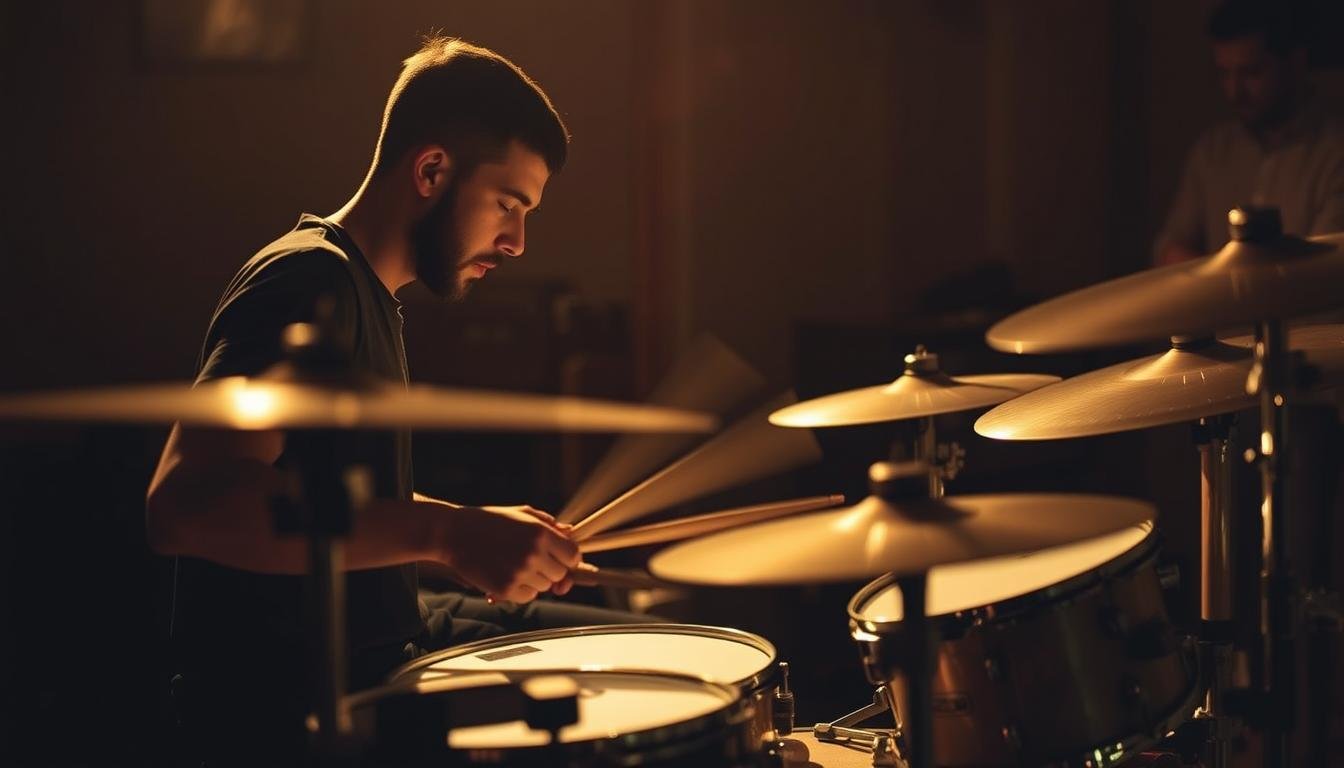
Welcome to your journey into drumming fundamentals! Whether you’re starting with sticks or improving your skills, learning basic patterns is key. These patterns are the foundation for everything you’ll play.
Drum rudiments for beginners boost speed, control, and coordination. They help you develop musicality and precision. This is what makes good players great. Mastering these essential drum rudiments is vital for every drummer.
This guide covers single strokes, double strokes, paradiddles, flams, drags, and vital rolls. With regular practice and the right approach, any drummer can master these skills. Your hard work in learning essential drumming techniques will reward you in amazing ways.
Let’s explore the patterns that will take your playing to new levels!
The practice of these essential drum rudiments will elevate your drumming to the next level!
Key Takeaways
- Foundational sticking patterns form the basis of all percussion techniques and musical expression
- Regular practice of basic patterns improves speed, control, and hand coordination significantly
- Single strokes, double strokes, and paradiddles are the most important patterns to learn first
- Flams, drags, and rolls add texture and dynamics to your playing vocabulary
- Consistent daily practice yields better results than occasional long sessions
- These skills benefit players at all levels, from complete beginners to advanced musicians
Why Drum Rudiments Are the Foundation of Great Drumming
Drum rudiments are like the alphabet of drumming. They are the basic patterns that make up every beat, fill, and solo. Without mastering these essential drum rudiments, you’ll find it hard to play complex techniques or express yourself musically. Learning drumming fundamentals through rudiments lets you communicate musically in any style or genre.
Practicing drum rudiments helps you develop many skills at once. Your hands learn to work together perfectly, even when they’re moving fast. This lets you focus on being creative during performances, not just on the mechanics.
Rudiment training does more than just improve hand movements. It builds the core skills every drummer needs:
| Skill Area | How Rudiments Help | Musical Result |
|---|---|---|
| Stick Control | Repetitive patterns train consistent striking technique and rebound management | Clean, articulate notes at any volume or tempo |
| Hand Speed | Progressive practice builds fast-twitch muscle response and endurance | Ability to execute rapid fills and complex patterns effortlessly |
| Coordination | Alternating hand patterns strengthen independent limb control | Smooth transitions between drums and cymbals during grooves |
| Dynamic Control | Practicing rudiments at various volumes develops touch sensitivity | Musical expression through controlled volume changes and accents |
Professional drummers in every genre rely on these drumming fundamentals. Rock drummers use paradiddles for powerful tom fills. Jazz players add flams and drags to the ride cymbal for subtle textures. Metal drummers use double strokes for speed.
Funk and Latin percussionists use rudiments in intricate groove patterns. The common thread? All these musicians practiced drum rudiments until they became second nature.
Many drummers think rudiments are only for marching band or are boring. But this is not true. Every impressive drum solo, every tight groove, and every creative fill you’ve heard has rudiment DNA.
The patterns might seem mechanical on a pad, but they become musical gold when used creatively. A simple single stroke roll can become the base for complex tom patterns. Flamacues add sophisticated accents to your snare work.
Some think rudiments take years to master before they’re useful. But the truth is, you’ll see drum technique improvement in weeks of consistent practice. Your grooves will get tighter, your fills will flow better, and your confidence will soar.
The link between mastering rudiments and musical expression is strong. When your hands play patterns automatically, your mind can focus on dynamics, phrasing, and playing with others. You’ll stop worrying about how to play and start thinking about what to play.
This shift in thinking sets apart drummers who just keep time from those who truly make music. Rudiments give you the technical freedom to explore creative ideas without being held back by mechanics.
Just 15-20 minutes a day of rudiment practice can make a big difference. You’ll get faster, your stick control will improve, and your hands will work together better. This lets you play complex patterns you thought were impossible.
And the best part? These benefits show up right away in your music. The groove you struggled with last month will now feel easy. The fill you’ve been working on will flow effortlessly. Your whole approach to the drum kit will become more fluid and confident.
Remember, every world-class drummer started where you are now. They practiced regularly, trusted the process, and saw their skills grow. By focusing on drumming fundamentals through dedicated rudiment work, you’re following the same path that has made countless successful drummers.
The Single Stroke Roll: Your First Building Block
Imagine a simple pattern that’s the core of every drum groove, fill, and solo. The single stroke roll alternates hands, using the pattern RLRL or LRLR. It might seem simple, but it’s crucial for mastering drumming.
Professional drummers always work on their single strokes. This pattern is found in rock, jazz, marching, and orchestral music. Watching your favorite drummer perform fast fills shows their single stroke skill.
Mastering this rudiment takes time and effort. It improves hand independence, endurance, and lays the groundwork for more complex patterns. Let’s explore what makes this rudiment powerful and how to master it.
What Makes the Single Stroke Roll Essential
The single stroke roll is like the alphabet of drumming. It’s the foundation for more advanced patterns. It helps develop even hand strength, ensuring both hands work equally.
Drummers face the challenge of hand balance. Your dominant hand might try to control too much, leading to uneven sound. Single stroke practice helps both hands work together, improving coordination.
Speed development relies on this pattern. Practicing at different tempos trains your muscles to respond quickly. The alternating motion allows for faster playing than one-handed strokes.
This rudiment is used in many musical contexts. Rock beats use it on the hi-hat, jazz on the ride cymbal, and funk in ghost notes. It’s a key drum rudiment for beginners to learn early.
It also builds endurance for longer playing. Alternating hands smoothly reduces fatigue and tension. This is crucial during performances or long practice sessions.
Proper Hand Technique and Stick Control
Your grip is the foundation of single stroke technique. Hold the stick between your thumb and index finger, with other fingers guiding. The grip should be firm but allow for natural rebound.
Matched grip is best for beginners. Both hands mirror each other, making learning easier. Palms face downward, with sticks angled slightly inward.
Wrist motion is key. Your wrists should lift and drop the sticks in smooth arcs. Avoid excessive arm movement, which creates tension and limits speed.
Stick height consistency is important. Start with 6-inch heights, measured from the drumhead to the tip of the stick. Both hands should reach the same height on every stroke.
Finger control adds finesse to your single strokes. After striking the drum, your fingers catch and control the rebound. This technique, called the Moeller method, allows for faster playing with less effort.
Relaxation is crucial. Tension in your hands, wrists, or arms will slow your progress and risk injury. Check your shoulders regularly—they should stay low and relaxed.
The fulcrum point, where your thumb and index finger grip the stick, determines your control level. Position this grip point about one-third from the bottom of the stick. This balance point allows optimal rebound while maintaining control.
Practice with different dynamics to develop true control. Play single strokes at forte (loud), mezzo-forte (medium), and piano (soft) volumes. This variation builds nuanced control that separates mechanical playing from musical expression.
| Technique Element | Correct Approach | Result |
|---|---|---|
| Grip Pressure | Firm but relaxed, allowing stick rebound | Increased speed and reduced fatigue |
| Stick Height | Consistent 6-inch heights from both hands | Even volume and better control |
| Motion Source | Wrist-driven with minimal arm movement | Efficient technique and greater endurance |
| Finger Control | Active fingers catching and guiding rebound | Enhanced speed and refined articulation |
Common Mistakes That Slow Your Progress
Gripping too tightly is a common error. It blocks natural rebound and creates tension. This leads to hand fatigue, slower speeds, and potential injuries. Check your grip often—you should be able to wiggle your fingers slightly while maintaining control.
Inconsistent stick heights create uneven sound. Many drummers favor their dominant hand, lifting it higher and striking harder. Record yourself practicing and watch for height differences. Your weaker hand needs extra attention to match your stronger hand’s natural motion.
Rushing the tempo derails progress faster than almost any other mistake. Beginners often try to play faster than their technique allows, resulting in sloppy, uneven strokes. The metronome becomes your best friend here. Start at comfortable tempos where you maintain perfect technique, then increase speed gradually over weeks and months.
Using arm motion instead of wrist motion wastes energy and limits potential. Your arms should remain relatively still, with wrists doing the primary work. When you engage your entire arm, you tire quickly and sacrifice the fluid motion needed for fast, controlled playing. Focus on isolated wrist movement during stick control exercises.
Neglecting the weaker hand perpetuates imbalance. Right-handed players often let their left hand lag behind in development. Left-handed drummers face the same issue in reverse. Dedicate specific practice time to your weaker hand, starting each exercise with that hand to ensure equal development. This attention to detail distinguishes serious students from casual players.
Tensing shoulders and arms blocks the relaxed flow essential for great technique. Stress and concentration often cause drummers to raise their shoulders and tighten their muscles. Take regular breaks to check your body position. Drop your shoulders, breathe deeply, and reset your posture. Physical tension directly translates to technical limitations.
Playing without goals or assessment prevents measurable improvement. Many drummers practice single strokes mindlessly, never checking their evenness or increasing difficulty. Set specific targets: play 60 seconds at 120 BPM with perfect evenness, then increase to 130 BPM. These benchmarks provide motivation and clear feedback about your progress with drum rudiments for beginners.
Ignoring dynamics and musicality turns practice into mechanical repetition. Single strokes aren’t just about speed—they’re about expression. Practice crescendos (getting gradually louder) and decrescendos (getting gradually softer). Add accents to specific beats. This musical approach keeps practice engaging while developing the control professionals demonstrate.
Remember that even world-class drummers continuously refine their single stroke technique. This rudiment never becomes obsolete or fully mastered. Each practice session offers opportunities to improve evenness, increase speed, or enhance control. Approach your stick control exercises with patience and curiosity, celebrating small improvements along your drumming journey.
The Double Stroke Roll: Doubling Your Speed and Power
Double stroke rolls bring speed, power, and smooth flow to drumming. They are a key essential drumming technique. Unlike single strokes, where hands alternate, double strokes have each hand hitting twice before switching.
This simple change opens up new possibilities. You’ll play faster with less effort. Your fills will become more complex and engaging.
The secret lies not in muscle power, but in understanding how your sticks naturally want to move.

Understanding the Bounce and Rebound Technique
Double strokes work on a surprising principle. Beginners often try to force both strokes equally, which limits speed. Instead, use the stick’s rebound after the first strike.
When your stick hits the drum, it bounces back up. This bounce energy gives you the second stroke almost for free. Your job is to control this bounce, not fight it.
At slower tempos, you’ll use more wrist control for both strokes. Each hit needs conscious effort and precise timing. As you speed up, the technique shifts to rely more on bounce.
The transition from wrist-controlled doubles to bounce-driven doubles is where most drummers struggle. Trust the rebound and let physics do the work.
Think of it like dribbling a basketball. At first, you push the ball down with effort. As you improve, you learn to feel the ball’s natural bounce and simply guide it. Your drum sticks work exactly the same way.
Low-speed doubles need clear articulation between both notes. You’ll hear distinct “ta-ta” sounds from each hand. High-speed doubles blur into a smooth roll where the bounce creates seamless flow between strokes.
Step-by-Step Practice Approach for Doubles
Building solid double strokes requires patience and systematic practice. Start at a tempo where you can play each stroke with complete clarity—usually around 60-80 beats per minute.
Here’s your practice roadmap for developing reliable drumming speed exercises:
- Establish evenness: Play RRLL patterns slowly, ensuring both right strokes sound identical in volume and timing, and both left strokes match perfectly.
- Focus on stick height: Keep your sticks at consistent heights between strokes—this creates uniform sound quality and prepares muscles for faster tempos.
- Increase by small increments: Raise your metronome by just 5 BPM once you achieve clean doubles at your current speed.
- Practice the transition zone: Spend extra time at the tempo where your technique shifts from wrist control to bounce control—usually between 120-160 BPM.
- Test your endurance: Play continuous double stroke rolls for 30-60 seconds at various tempos to build stamina.
The metronome becomes your best friend during this process. Set it to click on each individual stroke at first, giving you a reference point for perfect timing. As you improve, switch to clicks on just the downbeats.
A common pitfall involves rushing the second stroke of each hand. Your brain wants to move to the next hand quickly, cutting the second stroke short. Combat this by exaggerating the time between strokes initially, then gradually tightening the spacing.
Record yourself regularly. Your ears might deceive you during practice, but playback reveals the truth about stroke evenness and consistency.
Applying Double Strokes to Drum Fills and Solos
Now comes the exciting part—taking double strokes off the practice pad and into real drumming situations. These drum roll techniques transform ordinary fills into showstoppers when applied creatively around your kit.
One classic application involves alternating doubles between different drums. Try playing RRLL where the right hand hits the snare and the left hand hits the floor tom. The result creates a cascading effect that sounds far more complex than the simple pattern you’re executing.
Double strokes enable lightning-fast fills that would exhaust you with single strokes. A rapid double stroke roll descending across your toms creates dramatic buildups before chorus sections or song endings. The speed you achieve feels almost magical once the bounce technique clicks.
In drum solos, doubles let you explore polyrhythmic ideas and intricate patterns. Combine them with accents on specific beats to create compelling rhythmic conversations that hold audience attention.
| Musical Context | Double Stroke Application | Technical Benefit |
|---|---|---|
| Rock drum fills | Fast RRLL patterns moving between snare and toms | Creates powerful momentum and energy |
| Jazz brushwork | Smooth double strokes with brushes for sustained sound | Produces flowing, legato textures |
| Latin grooves | Double strokes on timbales or percussion | Adds authentic rhythmic ornamentation |
| Progressive metal | High-speed doubles across entire kit | Enables complex, technical passages |
Many legendary drum solos feature extended double stroke passages that showcase both speed and control. Listen to how drummers like Buddy Rich and Neil Peart wove doubles seamlessly into their improvisations, using them as launching pads for musical ideas rather than just technical displays.
Start incorporating doubles into your everyday grooves too. A quick RRLL on the snare during a chorus adds excitement without overwhelming the song. These subtle applications often impress musicians more than flashy solo work because they demonstrate musical maturity and restraint.
The journey to mastering double strokes takes weeks or months depending on your practice consistency. But every session moves you forward, and the payoff in expanded capability makes the investment worthwhile. Your drumming vocabulary literally doubles once these drumming speed exercises become second nature.
Paradiddles: The Gateway to Hand Coordination
Paradiddles unlock coordination skills that boost your drumming. They break the usual back-and-forth motion, making your brain work harder. This challenge improves your hand independence and control, key for drum technique improvement.
Paradiddles are special because they mix single and double strokes. Unlike simple patterns, they create a rhythmic “hiccup.” This trains your hands to move independently, essential for playing complex rhythms.
Mastering the Basic Single Paradiddle Pattern
The single paradiddle uses a sticking pattern of RLRR LRLL. Breaking it down helps you grasp each hand’s role.
It starts with two alternating strokes (R-L), then a double stroke on the right (R-R). The pattern mirrors, starting with the left hand: two singles (L-R) followed by a double (L-L). This creates a unique musical feel.
Success tip: Keep double strokes smooth and controlled. Avoid rushing or making them too loud. Aim for even volume and timing for all four notes.
Begin paradiddle exercises at a tempo where clarity is maintained. Count out loud to establish the rhythm. Doubles should bounce naturally, not forced.
Watch out for common mistakes:
- Making double strokes too loud or accented
- Rushing through the pattern without steady tempo
- Tensing up your grip during transitions
- Playing mechanically without sound quality
Double and Triple Paradiddle Variations
Mastering the single paradiddle opens the door to more complex patterns. These longer patterns add rhythmic variety and challenge your memory.
The double paradiddle adds more strokes: RLRLRR LRLRLL. It creates a six-note pattern, perfect for fills.
The triple paradiddle extends further: RLRLRLRR LRLRLRLL. With eight notes per cycle, it offers rich musical possibilities.
Use memory aids to learn these patterns. Think of adding pairs of singles before doubles. Single has one pair, double has two, and triple has three.
Practice each variation separately, focusing on smoothness. The extended patterns should flow naturally, without hesitation.
Creative Ways to Use Paradiddles Around the Kit
Paradiddles become musical tools when used creatively. They unlock new sounds and grooves that make your playing unique.
Begin by moving the basic paradiddle between snare and high tom. Play right-hand notes on the snare and left on the tom. This creates a complex groove.
Try these creative applications:
- Snare and floor tom combination: Alternate the pattern for a deep groove
- Hi-hat and snare split: Play right-hand notes on closed hi-hat and left on snare for a classic rock pattern
- Three-drum orchestration: Spread the pattern across snare, high tom, and floor tom for dramatic fills
- Cymbal integration: Replace specific notes with crash or ride cymbal hits to create accents
Accenting different notes changes the paradiddle’s feel. Try accenting the first note of each group or the doubles for a bouncy groove.
Paradiddles are incredibly flexible. They fit into various musical styles, from jazz to rock to funk. They adapt to any situation.
Don’t see paradiddles as rigid exercises. View them as tools for exploration and creativity. Experiment with dynamics and accents to find exciting sounds.
Flams: Adding Depth and Texture to Your Playing
Few essential drumming techniques have the immediate impact of a well-executed flam. It’s a cornerstone of expressive playing. Flam rudiments create a rich, full sound that adds dimension to your drumming. When played correctly, a flam creates a distinctive “fuller” tone that elevates any musical passage.
The beauty of flams lies in their versatility. They work equally well in powerful rock fills, subtle jazz accents, and everything in between. Once you understand the mechanics and timing, you’ll find yourself naturally incorporating flams into your playing.
The Anatomy of a Perfect Flam Stroke
Understanding what makes a flam sound right starts with recognizing its two distinct components. The grace notecomes first, played softly and close to the drum, while the primary note follows immediately with full power and height. These two strokes happen so close together that they create one unified sound rather than two separate hits.
The secret to clean flams is stick height control. Your grace note hand should stay low, typically just an inch or two above the drumhead. Your primary note hand needs to be at full height, around 6-8 inches for proper volume and tone.
Timing is everything when executing flam rudiments properly. The grace note should land just milliseconds before the primary stroke. If the gap is too wide, you’ll hear two distinct notes instead of a unified flam sound. If they’re too close together, the notes will blur into a messy, undefined tone.
Here’s a simple way to practice the feeling. Start with both hands at different heights as described above. Drop them simultaneously toward the drum. The lower hand naturally arrives first, creating the perfect flam timing. This physical approach helps your muscle memory understand the coordination needed for consistent drum technique improvement.
Flam Tap, Flam Accent, and Flamacue Variations
Once you’ve mastered the basic flam, several variations will expand your rhythmic vocabulary significantly. The Flam Tap combines a flam with an additional tap from the same hand that played the primary stroke. The sticking pattern flows as: LR-R-RL-L, where the first note of each pair is the grace note.
This pattern creates a triplet feel that’s incredibly useful for fills and transitions. Practice starting slowly, making sure each tap after the flam maintains consistent volume and spacing. The rhythm should feel natural and flowing, not choppy or forced.
The Flam Accent takes things further by adding specific accent patterns to your flams. You’ll play a flam followed by two taps, with the flam itself being the accented note. The sticking pattern is: LR-L-R-RL-R-L. This rudiment develops your ability to shift accents smoothly while maintaining the flam’s integrity.
The Flamacue is a compound rudiment that combines flam rudiments with single strokes. The pattern goes: LR-L-R-Lor RL-R-L-R. It starts with a flam and continues with three single strokes, creating a unique rhythmic phrase. This variation appears frequently in drum corps and marching band arrangements.
Each variation serves different musical purposes. The Flam Tap excels in groove situations, the Flam Accent provides dynamic control practice, and the Flamacue offers a quick, punchy phrase for fills. Working through all three builds comprehensive hand coordination and timing precision.
| Flam Variation | Sticking Pattern | Count Structure | Primary Musical Use |
|---|---|---|---|
| Flam Tap | LR-R-RL-L | Triplet-based (1-trip-let 2-trip-let) | Groove embellishments and smooth fills |
| Flam Accent | LR-L-R-RL-R-L | Groups of three (1-2-3 1-2-3) | Dynamic control and accent development |
| Flamacue | LR-L-R-L | Sixteenth note grouping (1-e-&-a) | Quick fill phrases and transitions |
| Basic Flam | LR or RL | Single beat emphasis | Accent placement and textural variety |
Musical Applications for Flam Rudiments
Understanding technique matters little without knowing how to apply it musically. Flams shine when used to emphasize important beats in your grooves. Try adding a flam to beat two and four of a basic rock pattern. The added thickness transforms your backbeat into something more powerful and attention-grabbing.
In fill situations, ending phrases with flams creates dramatic punctuation. Instead of landing on a single crash cymbal hit, play a flam between your snare and floor tom simultaneously with the crash. This approach is a favorite among rock and metal drummers for its sheer impact and authority.
Jazz drummers use flams more subtly, often incorporating them into ride cymbal patterns or as gentle accent colors on the snare. The essential drumming techniques you develop through flam practice translate directly to more nuanced musical expression in jazz contexts. A well-placed flam can add just the right touch of emphasis without overwhelming the musical conversation.
Latin and world music styles benefit tremendously from flam applications too. On timbales, congas, and other hand drums, the flam concept translates to creating fuller tones through strategic timing. Even though you’re not using sticks, the principle of slightly offset strokes remains the same.
For solo development, try orchestrating your flam rudiments around the entire drum kit. Play the grace note on one drum and the primary stroke on another. This creates cascading effects that sound impressive while reinforcing your technique. Move the pattern from high toms to low, or zigzag between different drums for creative sonic possibilities.
Don’t overthink when to use flams in your playing. Start by inserting them in comfortable spots during fills, then gradually experiment with groove integration. Your ears will guide you toward musical applications that fit your style. The key is building enough technical comfort that flams become a natural expressive choice rather than a challenging trick you’re trying to execute.
Recording yourself regularly helps identify where flams enhance your playing versus where they might be overdone. Balance is essential—flams should add spice to your drumming, not dominate every phrase. With consistent practice and musical awareness, these versatile rudiments become one of your most valuable tools for drum technique improvement and creative expression.
Drags: Creating Powerful Rhythmic Accents
Drags are your secret weapon for adding explosive accents and rhythmic punch to your playing. These dynamic rudiment patterns combine quick grace notes with a primary stroke. This creates a snapping, articulated sound that cuts through any musical context.
Drags might seem complex at first, but they’re built on a simple concept you already know. Mastering them is rewarding and immediate. You’ll notice professional drummers using drags constantly once you understand how they work.
The Architecture of Drag Rudiments
A drag consists of two quick grace notes followed by a primary accented stroke. Think of it as a double-stroke “ruff” that leads into the main note. The grace notes are played so rapidly that they almost blur together, creating a single textured sound.
The key to drum technique improvement with drags lies in understanding the distinction between the grace notes and the primary stroke. Your grace notes should be played low and quiet, barely lifting off the drum. The primary stroke, on the other hand, comes from a higher stick position and lands with authority.
There are two main types of drags you’ll encounter. Unmeasured drags are played as quickly as possible, with the grace notes crushed together for maximum tightness. Measured drags have defined rhythmic values, typically written as thirty-second notes or sixteenth notes depending on the tempo and style.
The sticking for a basic drag follows a natural pattern. If your right hand plays the primary stroke, your left hand executes both grace notes beforehand (written as “LL R”). For a left-hand drag, you’d play “RR L”. This alternating approach keeps your hands balanced and sets you up for smooth transitions between rudiments.
Proper execution requires controlling the rebound on those grace notes. Let the stick bounce naturally for the first grace note, then control the second bounce slightly to prepare for the primary stroke. This controlled bounce is one of those essential drumming techniques that separates clean drags from muddy ones.
Essential Drag Pattern Variations
The single drag tap combines a drag with an additional tap from the same hand that played the primary stroke. The sticking reads “LL R R” or “RR L L”, creating a flowing four-note pattern. This rudiment builds independence and teaches you to maintain control after the accented drag stroke.
Start practicing single drag taps slowly with a metronome. Focus on keeping those first two grace notes tight and quiet while the following strokes remain even and consistent. Many drummers make the mistake of letting the second tap lose volume or clarity, so pay special attention to maintaining dynamic control throughout the pattern.
The drag paradiddle takes things up a notch by combining drag technique with paradiddle sticking. The full pattern is “LL R L R” for the right-hand version, or “RR L R L” for the left. This compound rudiment patterns creates a five-note grouping that’s incredibly useful for odd-time feels and complex fills.
Here’s a comparison of the fundamental drag rudiments and their characteristics:
| Drag Rudiment | Sticking Pattern | Note Count | Primary Application |
|---|---|---|---|
| Basic Drag | LL R or RR L | 3 notes | Accents and transitions |
| Single Drag Tap | LL R R or RR L L | 4 notes | Fills and hand development |
| Drag Paradiddle | LL R L R or RR L R L | 5 notes | Complex grooves and solos |
| Drag Paradiddle #2 | RR L L R L R or LL R R L R L | 7 notes | Advanced fills and independence |
The drag paradiddle #2 extends the concept further with the pattern “RR L L R L R”. This seven-note sequence creates fascinating rhythmic possibilities when applied around the drum kit. Practice each variation separately before attempting to combine them in musical contexts.
Putting Drags to Work in Your Playing
Drags shine brightest when you incorporate them into actual grooves and fills. Try adding a drag to the snare backbeat in a basic rock pattern. Instead of playing a simple “2” and “4”, play “LL 2” and “LL 4” with the grace notes falling just before the beat. This creates a syncopated feel that adds sophistication without changing the fundamental groove.
For drum technique improvement in fills, drags provide powerful accents at the beginning or end of phrases. A common approach is to play a drag on the downbeat of a fill, creating an explosive entry that grabs attention. The pattern might be “LL 1 e + a 2” where the drag lands on beat one, followed by faster single strokes.
Ghost note grooves benefit enormously from selective drag placement. Play quiet taps on the snare between backbeats, then add a drag before specific accents. The contrast between the soft ghost notes and the snappy drag creates dynamic variation that makes your grooves come alive.
In solo contexts, drags work beautifully for building tension and release. String together multiple drag patterns at different dynamic levels, moving them around the toms and cymbals. The textural quality of drags adds depth that pure single strokes can’t match.
Here are practical applications to try immediately:
- Groove enhancement: Add drags before the backbeat in funk and R&B patterns for extra pocket and swing
- Fill punctuation: Use drags at the start of fill phrases to create clear musical statements and powerful entries
- Dynamic shading: Incorporate soft drags in ballads and quiet passages for subtle textural variety
- Solo vocabulary: Alternate between drag patterns and other rudiments to create conversational phrasing in extended solos
- Cymbal accents: Apply drag motion to crash cymbals for orchestral-style swells and dramatic accents
The beauty of drags as essential drumming techniques is their versatility across all musical styles. Jazz drummers use them for brush work and subtle color. Rock players employ them for aggressive fills and powerful grooves. Concert percussionists rely on drags for precise orchestral articulation.
Start by isolating just one drag pattern each practice session. Work it slowly until the grace notes sound tight and the primary stroke pops clearly. Then gradually increase the tempo, maintaining that crisp quality throughout. Once comfortable, experiment with moving the pattern around your kit, hitting different drums and cymbals.
Remember that drags require patience and consistent practice to master. The coordination between the quick grace notes and controlled primary stroke takes time to develop. But the musical rewards are substantial, giving you a professional sound quality that elevates everything you play.
Drum Rudiments Every Drummer Should Master: Essential Rolls
Learning essential rolls makes your playing smooth and professional. Rolls are a family of drum roll techniques built on single and double strokes. They create sustained sounds and smooth phrases.
Every serious drummer needs to know these roll types. Each roll has its own musical purpose, from quick fills to dramatic crescendos. Learning these drum rudiments for beginners opens up new creative possibilities.
Understanding the math behind rolls helps you recognize and apply them musically. Most rolls have rapid strokes that end in an accented note. This creates rhythmic groupings that fit perfectly into your music.
The Five Stroke Roll and Its Applications
The five stroke roll has four rapid notes followed by an accented fifth note. You can start with either hand, making it versatile. The accent on the final stroke fits perfectly into musical phrases.
This roll is great for quick transitions between song parts. Drummers use it to add impact to snare hits or cymbal crashes. The buildup creates anticipation that releases on the accented stroke.
When practicing drum rudiments like the five stroke roll, count all five notes clearly. Make the first four strokes even and controlled before adding the accent. Gradually increase your speed while keeping the accent distinct.
Musical applications for the five stroke roll are widespread, from rock fills to jazz phrases. Try placing the accent on different drums around your kit. You’ll find many ways to use this pattern in grooves, fills, and solos.
Seven Stroke Roll for Smooth Transitions
The seven stroke roll has six rapid notes followed by an accented seventh note. This pattern creates smoother transitions between musical sections. The RRLRLLR or LLRLLRL sticking pattern flows naturally once you develop the rhythm.
Drummers often use seven stroke rolls to move between verses and choruses or to build tension before a climactic moment. The extra length gives you more time to develop musical ideas. This makes the pattern perfect for setting up dramatic accents on specific beats.
Practice this roll by breaking it into smaller groups first. Work on the first three strokes (RRL), then the next three (RLL), before adding the final accented R. Once the sticking feels comfortable, focus on even spacing and consistent volume until the accent.
The seven stroke roll shines in fill situations where you need something longer than a five stroke but shorter than a nine stroke. Experiment with different drumming speed exercises to build control at various tempos. Start slow and gradually increase speed while maintaining clarity in each stroke.
Multiple Bounce Roll for Sustained Sound
The multiple bounce roll—often called a buzz roll—works differently from counted stroke rolls. Instead of playing distinct strokes, you let the stick bounce rapidly against the drumhead. Each hand produces multiple bounces, creating a sustained, smooth sound.
This technique requires relaxed hands and proper grip pressure. Press the stick into the drumhead with controlled tension, allowing natural rebounds to occur. The goal is creating an even, continuous sound rather than hearing individual strokes.
Buzz rolls appear frequently in orchestral drumming and concert band music. They’re essential for creating long, sustained sounds that mimic the sustain of melodic instruments. Contemporary drummers also use buzz rolls to build tension or create unique textural effects.
Developing a quality buzz roll takes patience and consistent practice. Start by working on one hand at a time on your practice pad. Focus on producing an even sound with multiple bounces per motion. Then coordinate both hands to create a seamless, sustained roll.
Nine, Ten, and Longer Roll Variations
Longer roll variations follow the same mathematical structure as their shorter cousins. A nine stroke roll features eight rapid strokes plus one accent, while a ten stroke roll includes nine strokes and an accent. These extended patterns give you more options for filling different musical spaces.
The musical applications for longer rolls expand as the pattern length increases. Nine stroke rolls work perfectly for filling an entire measure in certain time signatures. Ten stroke rolls create interesting rhythmic possibilities because they resolve differently than odd-numbered patterns.
Understanding the relationship between roll length and musical timing helps you choose the right pattern. Count out the beats in your music and select a roll that resolves where you need the accent. This mathematical approach to drum roll techniques makes your playing more intentional and musical.
Even longer rolls—thirteen, fifteen, and seventeen strokes—exist for specific musical situations. These advanced patterns become useful as your playing develops. For now, focus on mastering five, seven, and nine stroke rolls before exploring extended variations.
Here’s a comparison of essential roll patterns to help you understand their structure and applications:
| Roll Type | Total Strokes | Sticking Pattern | Best Musical Use |
|---|---|---|---|
| Five Stroke Roll | 5 (4 + accent) | RRLLR or LLRRL | Quick fills and transitions |
| Seven Stroke Roll | 7 (6 + accent) | RRLRLLR or LLRLLRL | Smooth section changes |
| Multiple Bounce Roll | Unmeasured bounces | Continuous buzz on each hand | Sustained sounds and tension |
| Nine Stroke Roll | 9 (8 + accent) | RRLRRLRLLR or LLRLLRLLRL | Measure-length fills |
| Ten Stroke Roll | 10 (9 + accent) | RRLLRRLLRR or LLRRLLRRLL | Unique rhythmic resolutions |
Building proficiency with these roll patterns requires dedicated practice time and patience. Don’t rush the learning process—each roll has unique characteristics that deserve focused attention. Set realistic goals and celebrate progress as you develop cleaner, faster rolls.
Incorporate rolls into your daily practice routine alongside other practice drum rudiments. Spend five minutes on each roll type, working with a metronome to track improvement. Record yourself regularly to hear progress that might not be obvious during practice sessions.
Remember that rolls are fundamental building blocks of advanced drumming vocabulary. Every professional drummer you admire has spent countless hours developing these techniques. Your commitment to mastering rolls will pay dividends in every aspect of your playing, from grooves to solos to musical interpretation.
As you develop these drumming speed exercises, focus on maintaining evenness and control at all tempos. Speed will come naturally with consistent practice. The goal is developing rolls that sound smooth and musical, not just fast and technical.
Building Speed and Control Through Rudiment Practice
Speed without control is chaos. But, combining both through smart practice leads to musical excellence. Many drummers rush their development, trying to play fast before mastering the basics. This results in sloppy technique, inconsistent sound, and frustrating plateaus that stall progress for months or even years.
The best way to practice drum rudiments is with a systematic approach that focuses on accuracy over speed. Building a solid foundation of control at slower tempos allows speed to naturally follow as your muscle memory strengthens. Think of it like building a house—you need a strong base before adding height, or everything becomes unstable.
Developing both qualities simultaneously requires patience and strategic planning. Focus on specific stick control exercises that reinforce proper technique while gradually increasing your tempo. This balanced approach transforms raw practice time into genuine skill development that lasts a lifetime.
Starting Slow with Metronome Discipline
The metronome might seem like your enemy at first, but it’s actually your best friend for building rock-solid technique. Starting at a slow tempo allows your brain to form accurate neural pathways that become automatic over time. Most drummers should begin single stroke rolls around 60-80 BPM, while more complex patterns like paradiddles might require starting even slower at 50-60 BPM.
Setting your ego aside is crucial during this phase of development. Playing slowly feels boring and maybe even embarrassing, but this is where the real magic happens. Your hands learn the correct motions, your muscles develop memory, and your brain creates lasting connections that will serve you forever.
Resist the temptation to rush ahead before you’re ready. If you can’t play a rudiment cleanly and consistently for one full minute at a given tempo, you’re not ready to increase the speed. This discipline separates drummers who plateau quickly from those who continue improving year after year.
Focus on these essential elements during slow practice:
- Even spacing between each stroke with no rushing or dragging
- Consistent sound quality from both hands without volume fluctuations
- Relaxed grip that allows natural rebound without tension
- Proper posture maintaining good body alignment throughout
Progressive Tempo Increases for Lasting Results
Once you’ve mastered a rudiment at your starting tempo, it’s time to increase the speed systematically. The key is making small increments of 2-5 BPM rather than jumping ahead by 10 or 20 beats. These modest increases feel manageable and allow your technique to adapt without breaking down.
Many drummers encounter what instructors call “breaking points”—specific tempo ranges where technique must evolve to accommodate increased speed. For example, around 140-160 BPM, your wrist motion might need to shift slightly, or your finger control becomes more important for drumming speed exercises. Recognizing these transitions helps you adjust rather than fighting against natural biomechanics.
Practice each new tempo until it feels completely comfortable before moving forward. This might take several days or even weeks for challenging rudiments. Don’t view this as slow progress—you’re building a comprehensive skill set that will support advanced techniques later.
When you notice any of these warning signs, reduce your tempo immediately:
- Visible tension in your hands, wrists, or forearms
- Uneven sound quality or inconsistent stroke volume
- Difficulty maintaining the pattern for extended periods
- Mental strain or inability to think ahead in the pattern
The goal isn’t reaching maximum speed in one practice session. Instead, you’re gradually expanding your comfortable playing range while maintaining complete control. This patient approach to practice drum rudiments delivers sustainable results that continue improving over months and years.
Maintaining Stick Height and Dynamic Control
As your tempo increases, maintaining consistent stick heights becomes increasingly challenging yet absolutely essential. Uneven stick heights create volume inconsistencies that make your playing sound amateurish, regardless of your actual speed. Professional drummers keep their sticks at relatively equal heights even during the fastest passages, creating that smooth, polished sound that audiences love.
Start by practicing stick control exercises at comfortable tempos while watching your hands in a mirror. Notice if one hand lifts higher than the other, or if your stick heights change when you get tired. This visual feedback helps you make corrections before bad habits become ingrained in your muscle memory.
Dynamic control means intentionally choosing your volume level rather than losing control as speed increases. Many drummers unconsciously get louder as they play faster, which limits their musical expression. Practice playing rudiments at different volume levels—soft, medium, and loud—while maintaining the same tempo and technique.
Try this exercise to improve your dynamic awareness:
- Play a single stroke roll at 80 BPM at a very soft volume for 30 seconds
- Gradually increase to medium volume over the next 30 seconds
- Build to maximum volume while maintaining control for 30 seconds
- Reverse the process, gradually returning to soft playing
This type of controlled variation trains your hands to respond to your intentions rather than defaulting to one volume level. The ability to play fast passages softly is valuable for musical drumming, allowing you to create dynamics that serve the song rather than overpowering it.
Remember that controlled speed is musical mastery, while uncontrolled speed is just noise. When you can play any rudiment at any tempo with consistent stick heights and intentional dynamics, you’ve achieved true technical proficiency. This level of control opens up endless creative possibilities for applying rudiments in real musical situations.
How to Practice Rudiments Effectively Every Day
Many drummers know rudiments are key, but few know how to practice them well. The secret is a smart, consistent approach that fits into your daily life.
Practicing rudiments with purpose and structure can change your playing in 20 minutes a day. It’s about knowing what to practice, how long, and tracking your progress.
Creating a Structured 20-Minute Practice Routine
A good drum practice routine breaks your session into focused parts. You don’t need long practice sessions to see progress. Consistency beats duration every single time.
Start with a five-minute warm-up using basic single strokes at a comfortable tempo. This gets your hands loose and your mind focused. Your muscles need this preparation time to perform at their best.
Next, spend ten minutes on focused rudiment work. Pick two or three specific rudiments to concentrate on during each session. Work through them at various tempos, starting slow and gradually building speed.
Reserve the final five minutes for musical application. This is where you take those rudiments and apply them to actual grooves or fills on your kit. This step transforms technical exercises into real drumming vocabulary.
| Time Segment | Activity | Focus Area | Tempo Range |
|---|---|---|---|
| 0-5 minutes | Warm-up with single strokes | Loose, relaxed motion | 60-80 BPM |
| 5-10 minutes | Primary rudiment practice | Accuracy and evenness | 40-120 BPM progressive |
| 10-15 minutes | Secondary rudiment work | Speed and control | 50-100 BPM progressive |
| 15-20 minutes | Kit application and creativity | Musical integration | Varies by groove |
This template is flexible and should adapt to your personal goals. If you’re working on a specific rudiment for an upcoming performance, dedicate more time to it. The structure provides a framework, not a rigid rule.
Remember that short, focused sessions produce better results than occasional long practices. Your brain retains information more effectively with consistent daily exposure. Twenty minutes every day builds muscle memory fasterthan two hours once a week.
Balancing Practice Pad Work and Kit Application
One of the biggest mistakes drummers make is practicing exclusively on a pad or only on the kit. Both environments serve different but equally important purposes in your development.
Practice pads offer distinct advantages for building technique. They provide a consistent rebound surface that helps you focus purely on hand mechanics. You can practice anywhere—watching TV, during lunch breaks, or before bed—without disturbing anyone.
The pad is perfect for developing precision and clarity in your strokes. When you practice drum rudiments on a pad, you hear every inconsistency in your playing. This immediate feedback helps you correct problems quickly.
On the other hand, the drum kit is where rudiments come alive musically. The kit teaches you how to move rudiments around different drums and cymbals. It shows you how to apply technical patterns to real musical situations.
A balanced approach splits your practice time between both surfaces. Try spending 60% of your time on the pad for technical work and 40% on the kit for musical application. This ratio ensures you build solid fundamentals while developing creative expression.
When you move to the kit, don’t just repeat pad exercises. Orchestrate your rudiments across different drums. Turn a single paradiddle into a fill that travels around the toms. Apply flams to your snare and floor tom combination.
Integration is the ultimate goal. Practice a rudiment on the pad until it feels comfortable, then immediately take it to the kit. Ask yourself: “How can I use this pattern in a real groove or fill?” This question transforms isolated exercises into practical drumming tools.
Tracking Your Progress and Setting Milestones
Without tracking your progress, you’re practicing blind. You need concrete ways to measure improvement and celebrate your achievements along the journey.
Start a practice journal to document your daily sessions. Write down which rudiments you worked on, the tempos you reached, and any challenges you encountered. This simple habit creates accountability and reveals patterns in your development.
Your journal doesn’t need to be elaborate. A basic notebook works perfectly. Include the date, duration, specific exercises, metronome settings, and brief notes about what felt good or needs work.
Recording your playing provides another powerful feedback tool. Use your phone to capture short practice sessions every week. When you listen back, you’ll hear things you miss while playing. These recordings become milestone markers showing how far you’ve come.
Set specific, measurable goals for your rudiment practice. Instead of vague aims like “get better at paradiddles,” target concrete achievements. Examples include: “Play single paradiddles cleanly at 120 BPM” or “Execute five-stroke rolls with perfect stick heights.”
Break larger goals into smaller weekly milestones. If your target is mastering doubles at 140 BPM, set weekly checkpoints at 100, 110, 120, and 130 BPM. Each checkpoint gives you a reason to celebrate and motivation to continue.
Understand that progress isn’t always linear. Some weeks you’ll experience breakthroughs, while others feel like plateaus. These flat periods are normal and often precede major improvements. Your body and brain need time to consolidate new skills.
Celebrate every milestone, no matter how small. When you nail that challenging rudiment at a new tempo, acknowledge the achievement. Share progress with fellow drummers or your teacher. These positive reinforcements strengthen your commitment to daily practice.
Review your journal monthly to identify patterns. You might discover that certain practice times work better for you, or that specific warm-up routines lead to more productive sessions. Use these insights to refine your drum practice routine continually.
The combination of structured practice, balanced environments, and consistent tracking creates a system that guarantees improvement. When you know what to practice, how to practice it, and can see your progress clearly, mastering drum rudiments for beginners becomes an achievable and enjoyable journey.
Conclusion
You’ve learned about the drum rudiments every drummer should know. These include single strokes, paradiddles, flams, drags, and the complete roll family. These basics are your key to creative expression and technical skill.
Learning drum rudiments for beginners takes time. Even professional drummers spend years perfecting these patterns. Your progress comes from daily practice with your sticks and pad, building skills slowly.
These rudiments are more than just exercises. They’re the musical language that lets you express through rhythm. Mastering each pattern opens up new ways to create grooves, fills, and drumming ideas.
Begin with the basics today. Start with one rudiment and practice it slowly with a metronome. Focus on technique before speed. Your hands will learn through repetition.
Every famous drummer, like Steve Gadd, Neil Peart, and Buddy Rich, built their career on these basics. Their dedication to rudiments transformed their playing. Your hard work will do the same for you.
The journey ahead requires patience and dedication. Some days will be tough. But keep practicing. The moments of breakthrough make every session worth it. Your drumming dreams are within reach with consistent practice of these essential rudiments.
FAQ
What are drum rudiments and why should I learn them?
Drum rudiments are basic sticking patterns that are the building blocks of drumming. They are like the alphabet of drumming. Every drummer should master these patterns.Learning rudiments helps you develop stick control, hand speed, and coordination. They also improve dynamic control and muscle memory. These skills are essential for playing grooves, fills, and solos.Professional drummers in all genres rely on rudiments. They are crucial for drummers at every skill level.
How long should I practice drum rudiments each day?
A consistent 20-minute daily practice session is more effective than longer sessions. This focused time allows you to warm up, work on specific rudiments, and practice tempo variations.Structure your practice with 5 minutes for warm-up, 10 minutes for focused rudiment work, and 5 minutes for musical application. Consistency is key. Daily practice builds muscle memory and neural pathways more effectively than longer sessions.
Should I practice rudiments on a practice pad or on my drum kit?
The most effective approach is balancing both practice pad work and kit application. Practice pads are great for developing precise technique. They provide consistent rebound and can be practiced quietly anywhere.Kit application is also essential. It translates rudiments into real-world musical situations. Practicing rudiments around the drums and cymbals teaches you how to move patterns between different surfaces.A good approach is splitting your practice time. Do pad work for technical refinement and then move to the kit to apply what you’ve practiced in musical contexts.
Which drum rudiment should I learn first as a beginner?
Begin with the single stroke roll (RLRL or LRLR). It’s the most fundamental rudiment and the foundation for everything else. This alternating pattern develops even hand development, proper grip, and stick control.Once you can play smooth, even single strokes at various tempos, move on to the double stroke roll (RRLL). It introduces the concept of rebound and bounce technique. After establishing comfort with these two basic rolls, progress to paradiddles (RLRR LRLL).This logical progression builds skills systematically. Each rudiment prepares you for the next level of complexity.
How do I know if I’m playing a rudiment correctly?
Several checkpoints indicate correct rudiment execution. First, both hands should produce consistent volume and tone. If one hand sounds significantly louder or different, you need to work on evenness.Second, maintain consistent stick heights for the type of stroke you’re playing. This produces uniform sound and proper technique. Third, check for physical tension. Your grip, wrists, forearms, and shoulders should remain relaxed even as you play.Fourth, the rhythm should be perfectly even at slower tempos. Recording yourself and listening back objectively helps identify issues you might not notice while playing. Consider studying with a qualified drum instructor who can provide expert feedback.
What’s the difference between a flam and a drag?
Though both are grace note rudiments, flams and drags have distinct structures and sounds. A flam consists of two strokes played almost simultaneously. One hand plays a grace note slightly before the other hand plays the primary note, creating a “thickened” sound.The two notes are very close together but distinctly separate. A drag, on the other hand, consists of two quick grace notes immediately preceding a primary stroke. The drag’s two grace notes are played much closer together than flam notes, creating a quick “buzz” or “drag” sound leading into the main stroke.
How fast should I be able to play rudiments?
Speed benchmarks vary by rudiment and individual development, but control and cleanliness matter more than raw speed. For single stroke rolls, intermediate drummers typically achieve clean execution at 150-180 BPM (sixteenth notes).Double stroke rolls generally achieve higher speeds, with proficient drummers playing clean doubles at 180-220+ BPM. Remember, your goal should be playing each rudiment smoothly and evenly at gradually increasing tempos rather than rushing to specific speed targets.
Are drum rudiments only for marching band and orchestral drummers?
Absolutely not—this is a common misconception. While rudiments originated in military drumming and remain essential for marching percussion, they’re equally fundamental for drummers in every musical genre. Rock drummers like Neil Peart and Danny Carey built legendary techniques on rudiment foundations.Jazz masters like Buddy Rich and Tony Williams applied rudiments with incredible musicality and creativity. Metal drummers use rudiments to achieve the speed and precision their genre demands. Funk and Latin players rely on rudiment-based patterns for complex syncopated grooves.
What’s the best way to increase my rudiment speed without losing control?
The most effective method is slow, methodical practice with gradual tempo increases. Start each rudiment at a tempo where you can play it perfectly. Practice at this comfortable tempo until it feels effortless, then increase by just 2-5 BPM.Continue this process, spending adequate time at each tempo before progressing. If you notice tension creeping in, loss of evenness between hands, or sloppy technique, immediately reduce the tempo. Use a metronome religiously to maintain honesty about your tempo and evenness.
How do I apply rudiments musically instead of just practicing them as exercises?
The key to musical application is orchestrating rudiments around your drum kit and incorporating them into actual grooves and fills. Start by taking a rudiment like the paradiddle and instead of playing it all on one drum, move the pattern between different drums and cymbals.Change the accent patterns to create different rhythmic feels and dynamics. Practice inserting rudiments into the spaces within grooves you already know, using them as fill material between sections. Take a single stroke roll and practice it as a fill that travels around your toms, ending with a crash cymbal.
What is a multiple bounce or buzz roll, and how is it different from other rolls?
A multiple bounce roll (also called a buzz roll or press roll) is fundamentally different from single and double stroke rolls because each hand produces multiple rapid bounces rather than controlled individual strokes. Instead of playing distinct single strokes (RLRL) or defined double strokes (RRLL), you press the stick into the drumhead with controlled pressure, allowing it to bounce rapidly multiple times before the other hand does the same.This creates a smooth, sustained, “buzzing” sound without individual strokes being audible—the goal is a continuous, seamless sound. The technique requires finding the right balance between pressure and relaxation, using wrist motion to press the stick into the head while allowing the stick’s natural vibration to create the bounces.