
Music production has changed a lot in the last ten years. Many artists now use software instead of big hardware setups. This makes it easier to get great guitar sounds without the hassle of setting up loud cabinets in small rooms.
Digital modeling lets you access a huge range of sounds, from old to new. You don’t need to spend thousands of dollars or take up a lot of space. These tools are super flexible, so you can change your sound even after you’ve recorded it.

Learning to use these digital tools is key for today’s producers. This guide will show you the best amp sims in logic pro (and how to use them for realistic tone). By following these tips, you can get professional-sounding results that are just as good as recordings from big studios.
Key Takeaways
- Digital modeling saves a lot of space and money compared to real hardware.
- Software lets you edit your guitar sound without changing the original recording.
- Modern plugins can make your sound sound just like classic tube amps.
- Getting the right gain is crucial for a natural, professional sound.
- You can mix and match different virtual cabinets to create unique sounds.
The Foundation of Realistic Guitar Tone in Logic Pro
To get a realistic tone in Logic Pro, it’s not just about choosing the right amp model. Professional results come from managing the digital signal path carefully. This ensures your audio stays intact.
Keeping technical discipline helps make software sound like top-notch hardware. This starts with how your guitar connects to your interface and goes through virtual components.
Understanding the Digital Signal Path
The digital signal path is key to your sound. When using logic pro amp sims, the software needs a clean signal from your guitar. If the signal is bad from the start, no processing can fix it.
To keep a high-quality signal, follow these steps:
- Connect your guitar directly to the Hi-Z input on your audio interface.
- Make sure your interface gain is set right to capture a strong, clean signal without clipping.
- Keep your virtual signal chain organized to avoid latency or phase issues.
The Importance of Gain Staging
Proper gain staging is crucial for a professional logic pro guitar tone. It prevents digital distortion and makes your virtual pedals and amplifiers act like real ones.
If your input signal is too loud, you’ll get harsh digital clipping before it hits the amp. On the other hand, a too-quiet signal means you’ll have to boost it later. This increases the noise floor and lowers your audio quality.
“Gain staging is the art of managing the volume at every stage of your signal chain to maintain the best possible signal-to-noise ratio.”
Always aim for a healthy input level that leaves room for your plugins to work well. By mastering these levels, you lay a solid foundation for your virtual gear to shine.
Best Amp Sims in Logic Pro (And How to Use Them for Realistic Tone)
Starting with using amp sims in logic pro opens up a world of sound. Choosing the right software is key to capturing your performance’s essence. These amp sim plugins for logic pro are now the go-to for modern recording.
These tools offer results that match the quality of real hardware. Learning to use them well lets you get a tone that fits perfectly in any mix.
Neural DSP Archetype Series
Neural DSP has changed the game with its hyper-realistic modeling. Each Archetype plugin is based on a famous artist’s sound, giving you a unique experience.
- Unmatched dynamics: These plugins respond to your playing just like a real amp.
- Integrated effects: You get top-notch pedals and studio-grade effects in one place.
- User-friendly UI: The easy layout helps you find a great tone quickly.
Line 6 Helix Native
Line 6 is a big name in digital modeling. Their Helix Native software brings their top hardware to your DAW.
It’s incredibly versatile, with hundreds of amps, cabinets, and effects. It’s great for producers working on many genres at once.
IK Multimedia Amplitube 5
Amplitube 5 is a huge system with lots of gear. It’s perfect for those who love trying out different setups and vintage sounds.
The cabinet simulation is top-notch, letting you move microphones around the speaker. This level of control is crucial for a realistic sound.
| Plugin | Best For | Key Strength |
|---|---|---|
| Neural DSP | Modern Metal/Rock | Dynamic Response |
| Line 6 Helix | Versatility | Massive Gear Library |
| Amplitube 5 | Vintage/Custom | Cabinet Customization |
The best amp sims in logic pro vary based on your needs. Whether you want simplicity or customization, these tools will make your guitar tracks sound professional.
Native Logic Pro Amp Designer Deep Dive
Many producers miss out on the power of Amp Designer in Logic Pro. This plugin has tools that match expensive third-party options. By using these logic pro amp sim tips, you can get pro results right in your DAW.
Navigating the Amp Designer Interface
The interface is easy to use, guiding your signal from amp to cabinet to mic. You can switch amp models by clicking the top of the plugin. Try different models to find the best tone for your guitar.
The layout is clear, making it easy to see how your sound is processed. Each control feels real, giving you a genuine experience. This makes it a top choice for both beginners and pros.
Customizing Cabinets and Microphones
After picking your amp, the cabinet section is key for shaping your tone. You can pick from various speaker setups to change your sound. Changing the virtual microphone position is also crucial, just like in real recording.
Moving the mic closer to the speaker adds brightness. Moving it away makes the sound warmer. These small changes are key to enhancing your logic pro amp sims.
Utilizing the Built-in Pedalboard
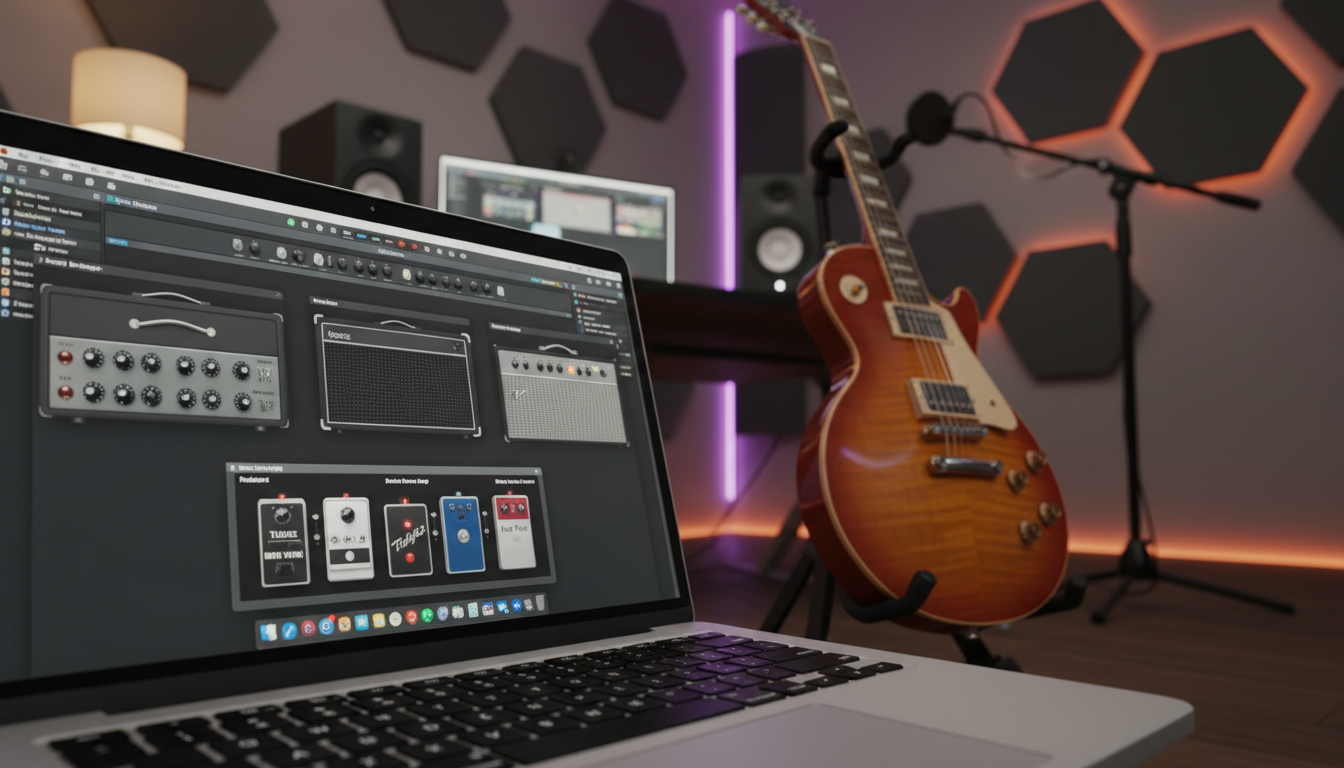
The pedalboard lets you add effects before the amp. You can add distortion, modulation, or delay. With these logic pro amp sim tips, you can create a complete, polished sound ready for mixing.
| Feature | Function | Benefit |
|---|---|---|
| Amp Models | Emulates classic tube circuits | Authentic harmonic saturation |
| Cabinet Selection | Changes speaker resonance | Customizable frequency response |
| Mic Placement | Adjusts axis and distance | Precise tonal control |
| Pedalboard | Adds pre-amp effects | Creative sound design |
Third-Party Powerhouses for Professional Results
Ready to take your guitar recordings to the next level? Third-party amp sim plugins for logic pro offer unmatched depth and flexibility. They go beyond standard presets, adding unique features that boost your production quality. With these tools, you can achieve a signature sound with special distortion and cabinet responses.

Softube Amp Room
Softube Amp Room is a masterpiece in digital modeling. It’s a modular platform that lets you build your signal chain like a real studio. You can mix and match amplifiers, cabinets, and pedals for a custom rig that responds to your playing.
Brainworx bx_rockrack V3
For a streamlined workflow, Brainworx bx_rockrack V3 is a great pick. It captures the essence of legendary hardware without complex menus. This plugin is ideal for those who want a professional tone quickly, with the punch and clarity of high-end tube gear.
“The secret to a great guitar track isn’t just the gear; it’s how the software reacts to your touch and the nuances of your performance.”
Positive Grid BIAS Amp 2
Positive Grid BIAS Amp 2 shines with deep component-level modeling. You can swap out virtual tubes, transformers, and capacitors for fine-tuning. It’s a top choice for those who love to experiment with circuit design.
| Plugin Name | Best For | Key Strength |
|---|---|---|
| Softube Amp Room | Modular setups | Authentic studio feel |
| Brainworx bx_rockrack V3 | Fast workflow | Hardware-like punch |
| Positive Grid BIAS Amp 2 | Deep customization | Component modeling |
Essential Signal Chain Techniques for Realism
To get a pro guitar sound, start before you use plugins. When using amp sims in logic pro, your raw signal is key. A clean signal lets your virtual gear sound just like real hardware.
Setting Up Your DI Input
Recording guitars in logic pro begins with your input gain. Make sure your audio interface is set to “Hi-Z” or “Instrument” input. Too high gain can cause digital clipping, ruining your sound.
Strive for a signal level that peaks at -12dB to -6dB on your channel meter. This level gives your plugins room to work without distortion. Keeping this level consistent is crucial for the best virtual rig performance.
The Role of Pre-Amp Effects
Before reaching the virtual amp, pre-amp effects can shape your tone. Using a virtual overdrive or compressor pedal before the amp sim is like a real pedalboard. It offers several benefits:
- Tightening the low end with an overdrive pedal at low gain.
- Adding sustain with subtle compression before the amp.
- Shaping the frequency response to cut muddy frequencies early.
Managing Latency for Natural Performance
Latency can ruin your flow during recording. To manage logic pro amp sim tips, adjust your buffer size. A lower setting, like 64 or 128 samples, reduces delay.
If your computer can’t handle low settings, try these fixes:
- Turn off power-hungry plugins on other tracks while recording.
- Use the “Low Latency Mode” in the Logic Pro transport bar.
- Freeze tracks not being recorded to save CPU.
Keeping your system responsive lets you focus on playing. A smooth, lag-free experience is vital for capturing your playing’s nuance and feel.
Mastering Impulse Responses and Cabinet Simulation
Many producers say the secret to a realistic tone in Logic Pro is impulse responses. Stock cabinet simulations are easy but lack the unique character of professional recordings. By using custom impulse responses, you control your guitar’s sound exactly.
What are Impulse Responses
An impulse response, or IR, is a digital snapshot of a space or speaker cabinet. It shows how a cabinet, microphone, and room affect sound. Think of it as a sonic fingerprint for your guitar signal.
Using an IR is like placing your digital amp in a real speaker. This adds depth and complexity for a realistic tone in Logic Pro. It also gets rid of the “fizz” from basic digital modeling.
Loading Third-Party IRs in Logic Pro
Logic Pro makes adding these files easy. Use the Space Designer plugin to load WAV-based IR files. Just open the plugin, go to the impulse library, and import your cabinet file.
Some guitarists prefer third-party IR loader plugins for better workflow. These plugins offer features like latency-free processing and easy file management. Using high-quality IRs greatly improves your production.
Blending Multiple Cabinet Microphones
The real magic is in layering different microphone positions. Mixing a dynamic mic for punch with a ribbon mic for warmth creates a unique sound. This technique helps you craft a realistic tone in Logic Pro that feels real and three-dimensional.
Be careful of phase cancellation when mixing signals. If your sound is thin or hollow, try flipping the phase on one mic. Adjusting volume and panning between layers will give you professional results every time.
Advanced Tone Shaping with EQ and Compression
Improving your guitar tracks needs careful use of EQ and compression. Amp sims give the main sound, but the last touches come from EQ and compression. Learning to use these tools well is key to getting a top-notch logic pro guitar tone that blends well with other sounds.
Subtractive EQ Before the Amp
First, clean up the raw DI input before it reaches the virtual amp. Getting rid of unwanted low-end rumble or harsh resonances is crucial. A high-pass filter at 80Hz helps remove unnecessary low-end that can mess with your bass.
Also, look for boxy sounds in the low-mids, around 300Hz to 400Hz. Subtractive EQ at this point makes sure the amp sim only works with the best parts of your playing. This is a key part of effective logic pro tone shaping.
Additive EQ After the Cabinet
After the signal goes through the cabinet simulation, you might want to add some sparkle. Additive EQ lets you enhance the “air” or “bite” of your guitar without making it harsh. A gentle high-shelf boost above 5kHz can make your pick attack clearer.
“The secret to a great guitar sound is not just the gear you choose, but how you carve out space for it in the frequency spectrum.”
If your tone seems too dark, try boosting the 2kHz to 3kHz range. This helps your guitar stand out in the mix, perfect for rock or metal. Always check how it sounds to make sure it feels natural.
Using Compression to Emulate Tube Sag
Real tube amps compress the signal when you play hard. This “tube sag” adds a natural feel and sustain. You can mimic this in your DAW with a compressor.
- Ratio: Keep it low, around 2:1 or 3:1, for a natural feel.
- Attack: Use a medium-slow attack to let the initial transient punch through.
- Release: Set the release to match the tempo of your song for a musical pumping effect.
Using this technique adds a professional touch to your logic pro guitar tone. It makes your virtual rig sound more alive and responsive. With consistent logic pro tone shaping, your tracks will sound sharp and ready for release.
Troubleshooting Common Digital Tone Issues
Even the most advanced digital setups can sometimes face technical problems. These issues can slow down your creative work when you’re recording guitars in Logic Pro. Luckily, most common problems can be fixed with a few easy steps.
Eliminating Digital Harshness
Digital harshness often comes from too much high-frequency content or wrong gain settings. If your sound feels too sharp or tiring, here are some quick fixes:
- Use a low-pass filter to cut off frequencies above 8kHz or 10kHz.
- Make sure your input levels are right to avoid clipping the plugin’s headroom.
- Apply a subtle de-esser or a dynamic EQ to soften sharp pick attacks.
Fixing Phase Issues in Stereo Rigs
Phase cancellation can make your guitar sound thin or hollow in stereo setups. This happens when two signals fight each other. To fix this, check the polarity of your tracks or adjust one track slightly to match the other.
Always listen in mono to check if your stereo image is strong. If the sound weakens or disappears in mono, you have a phase conflict that needs fixing.
Managing CPU Load with Freeze Tracks
High-quality amp simulations can be hard on your computer’s processor. If you see audio crackles or stutters, it’s time to optimize your session. The Freeze Track feature in Logic Pro is a great way to save resources while keeping your signal chain high-quality.
Freezing your tracks lets the software render the heavy processing into a temporary audio file. This simple logic pro tone shaping trick keeps your computer stable. It lets you keep creating without worrying about system overload.
Conclusion
Mastering amp simulation in Logic Pro is a mix of technical skill and creative vision. You now know how to handle complex signal paths. You can use tools from brands like Neural DSP, Line 6, and IK Multimedia.
Creating great guitar tone is about balancing gain and EQ. Every change you make gets you closer to a professional sound. This is what you find in top recording studios.
These software tools are like a canvas for your music. Your unique playing style is the most important part. Keep trying different settings to find your sound.
Improving your workflow takes time and practice. Spend time learning your favorite plugins. This will open up new sounds for you. Your journey to making top-notch guitar tracks begins with your next session.
Share your work with other musicians for new ideas. Your hard work with these digital tools will make your music sound professional. Start making your best music today.
FAQ
Are Logic Pro amp sims good enough for professional releases?
Yes, they are. Many professional records use Logic Pro amp sims or third-party plugins. When you add high-quality impulse responses and proper tone shaping, they sound just like real amplifiers.
How do I stop my guitar from sounding “fizzy” when using amp sims in Logic Pro?
To avoid “fizzy” sounds, use a low-pass filter in Logic’s Channel EQ. Roll off frequencies above 8kHz or 10kHz. Also, make sure your gain staging is correct to prevent digital clipping.
What is the best way to manage latency when recording guitars in Logic Pro?
To get a responsive tone, set your I/O Buffer Size to 128 samples or lower in Preferences > Audio. You can also use “Low Latency Monitoring Mode” to bypass plugins that cause delay.
Can I use third-party impulse responses with Logic Pro’s native tools?
Yes! You can bypass the cabinet in Amp Designer and load third-party IRs into Space Designer. This lets you use Logic’s amp heads with professional speaker captures from OwnHammer.
What are the most essential amp sim plugins for Logic Pro for metal players?
For metal, Neural DSP Archetype: Gojira and Brainworx bx_rockrack V3 are top choices. They provide the tight low-end and aggressive saturation needed for modern metal.
Is it better to put EQ before or after the amp sim?
Both EQ before and after the amp are crucial. Use subtractive EQ before the amp to clean up the DI signal. Additive EQ after the amp and cabinet simulation shapes the final sound and makes the guitar stand out in your mix.