
Entering a music store or browsing online for guitar pedals can be daunting. Thousands of colorful metal boxes promise to change your sound. But, where do you begin?
Here’s the good news: every legendary guitarist started just like you. Starting with guitar pedals doesn’t have to be confusing or costly.
These small metal boxes, also called stompboxes, have circuitry that activates when stepped on. They can drive, distort, modulate, and add reverb to your guitar tone. While your amp and guitar form the base, pedals open up endless sonic possibilities.
This guide will cover everything you need to know about guitar effects introduction. You’ll learn about the most important pedal types, how to make budget-friendly choices, and how to avoid common mistakes.
For beginners, it’s wise to start with reasonably priced, tried-and-tested stompboxes. These have simple controls. There’s no single “correct” path forward—different players need different effects based on their musical style and creative vision.
Key Takeaways
- Guitar pedals are stompboxes that shape your tone through distortion, modulation, and other effects
- Beginners should focus on affordable, user-friendly pedals with simple controls to learn the basics
- Your musical style determines which effects you’ll need—there’s no one-size-fits-all approach
- Understanding pedal types helps you make informed purchases without wasting money
- Every great guitarist started as a beginner, and this guide provides a clear roadmap for your journey
Understanding Guitar Pedals and Why They Matter
Every legendary guitar tone you’ve ever heard likely started with the creative use of effects pedals. These small metal boxes have shaped the sound of rock, blues, country, and countless other genres for decades. Getting familiar with pedal effects basics gives you the foundation to craft your own signature sound.
Guitar pedals sit between your instrument and amplifier, processing the electrical signal in specific ways. They’re not just accessories—they’re legitimate tools for musical expression that have defined entire eras of music. Understanding what these devices do helps you make smarter choices as you build your collection.
What Guitar Pedals Actually Do to Your Sound
The concept behind how guitar pedals work is simpler than you might think. Your guitar generates an electrical signal that travels through a cable to your amplifier. When you place a pedal in that signal path, it alters specific characteristics of that sound before it reaches the amp.
Different pedals modify different aspects of your tone. Some add grit and aggression through distortion. Others create space and depth with echo effects. A few change the texture entirely by modulating the signal in unique ways.
Most pedals feature simple controls that adjust how dramatically they affect your sound. A typical pedal might have knobs for volume, tone, and intensity. You activate them by stepping on a footswitch, which lets you turn effects on and off while playing.
The pedal is the thing that allows you to go from rhythm playing to lead playing instantaneously.
— Eddie Van Halen
The beauty of essential guitar pedals lies in their immediacy. One moment you’re playing clean jazz chords. The next, you stomp on an overdrive pedal and instantly transform into a rock powerhouse. This instant sonic flexibility makes pedals invaluable for live performance and recording.
How Pedals Transform Your Basic Tone
Your guitar and amplifier create your foundational sound. But pedals are the paintbrushes that add color, texture, and dimension to that canvas. They expand your creative possibilities far beyond what your instrument and amp can achieve alone.
Consider a simple three-chord progression played on a clean amp setting. It sounds fine but somewhat ordinary. Add a delay pedal, and suddenly those same chords create an expansive, atmospheric soundscape. The notes repeat and cascade, filling space in ways that feel almost magical.
Guitar tone transformation happens across multiple dimensions. A chorus effect makes your single guitar sound like multiple instruments playing together. A reverb pedal simulates the acoustics of different spaces, from small rooms to massive cathedrals. An overdrive adds warmth and sustain that makes leads sing.
| Pedal Type | Tonal Effect | Musical Application | Characteristic Sound |
|---|---|---|---|
| Overdrive | Warm saturation and compression | Blues solos, rhythm crunch | Natural tube amp breakup |
| Delay | Repeating echoes over time | Ambient passages, thickening leads | Spacious depth and dimension |
| Chorus | Doubled, shimmering texture | Clean arpeggios, jangly chords | Wide stereo-like presence |
| Reverb | Natural room acoustics | Everything from subtle to ambient | Spatial depth and cohesion |
These effects work individually or combine to create complex tones. Many professional guitarists use several pedals together, building layered sounds that define their musical identity. The right combination can make even a budget guitar sound professional and polished.
Why Starting with the Right Pedals Matters
Your first pedal purchases set the trajectory for your entire effects journey. Choosing wisely means building skills and understanding that inform better decisions down the road. Making poor choices leads to frustration, wasted money, and potentially giving up on effects altogether.
Starting with versatile, user-friendly essential guitar pedals gives you immediate results. You’ll hear improvements in your tone right away, which motivates continued exploration. These foundational effects teach you how to listen critically and adjust parameters for different musical contexts.
Unlike buying yet another guitar, pedals offer more immediate and dramatic sonic returns on investment. A $100 overdrive can completely transform how your current guitar sounds. That same money spent on a slightly different guitar might yield only marginal tonal differences.
The wrong first pedals can discourage beginners from exploring effects further. A complex multi-effects unit with hundreds of sounds might seem appealing, but it often overwhelms newcomers. A specialized boutique fuzz pedal might sound amazing in demos but prove too limited for learning fundamental pedal effects basics.
Smart first choices build confidence. When you understand how a basic overdrive responds to your playing dynamics, you develop intuition about gain staging. When you learn to set a simple delay tastefully, you grasp the concept of wet/dry balance. These skills transfer to every future pedal you encounter.
The pedals you start with also shape your understanding of what’s possible. Beginning with essential, widely-used effects gives you a common language with other guitarists. You’ll recognize these sounds in recordings and understand how professionals achieve their tones. This knowledge becomes the foundation for developing your own unique voice.
Choosing Your First Guitar Pedals! – A Beginners Guide to Essential Types
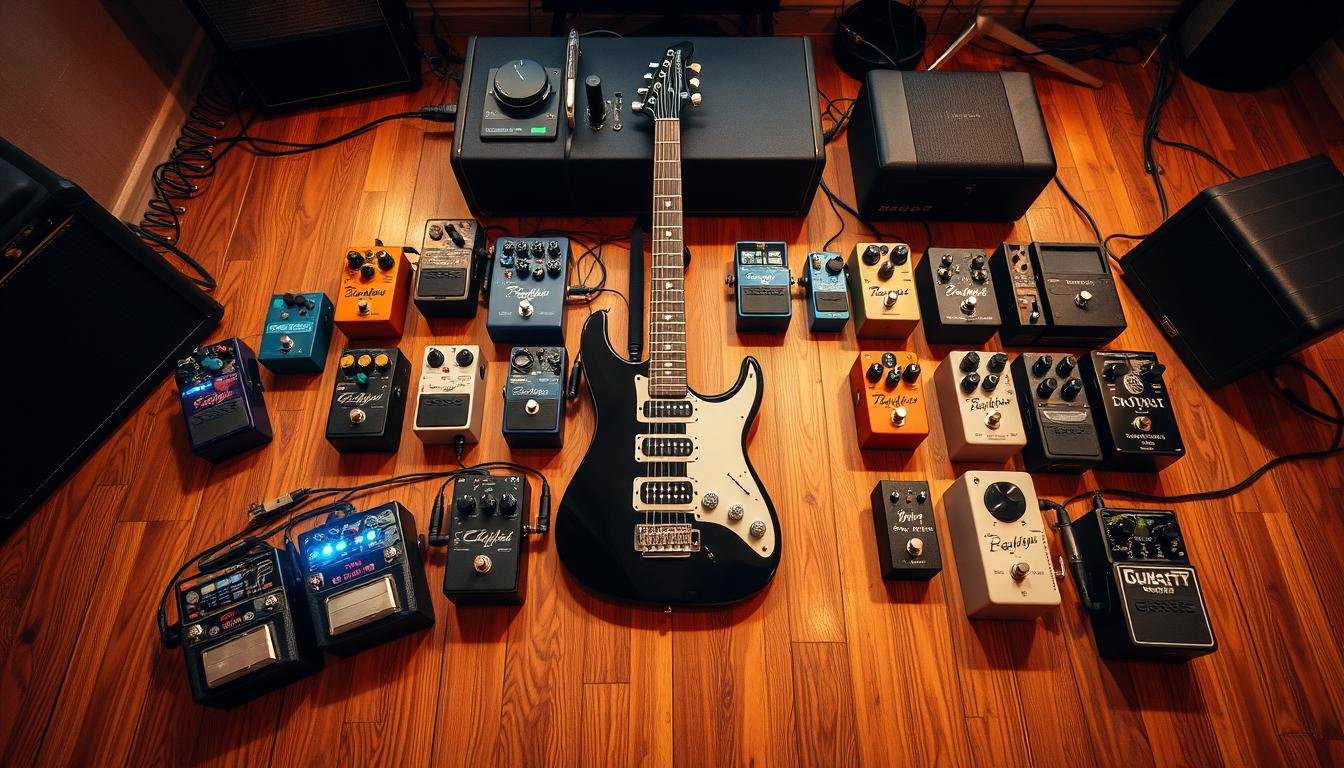
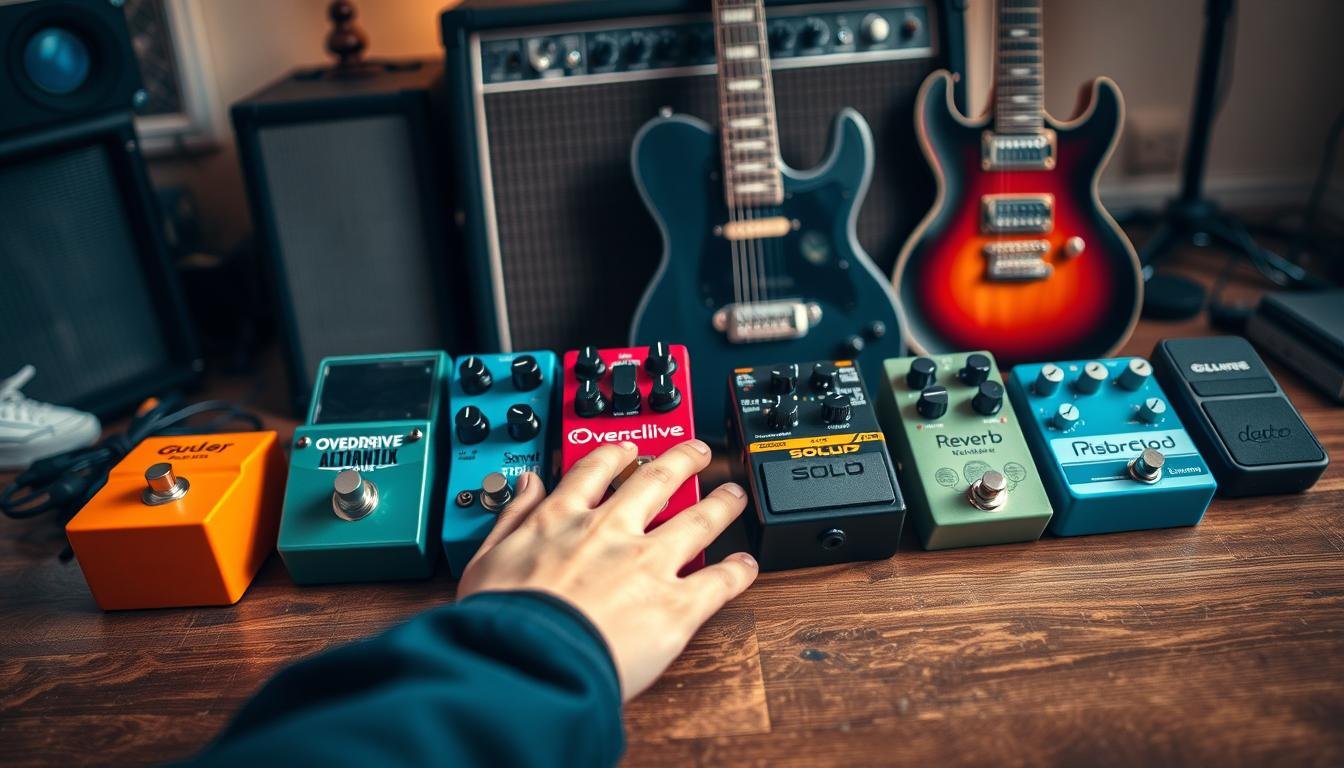
Walking into a music store can be overwhelming with all the pedals. But, there’s a smart way to start. Instead of picking pedals that look cool, learn how pros organize their gear. The best pedals for beginners fall into three main groups that shape your sound.
You don’t need to buy everything at once. It’s about knowing which effects fit your music style and goals.

The Three Must-Have Pedal Categories
Professional guitarists organize their pedals into three main categories. These categories aren’t just marketing tricks. They show how different effects change your sound and serve different musical needs.
The three essential types are drive effects, time-based effects, and modulation effects. Each type changes your tone in unique ways.
Understanding these categories helps you focus on what inspires you. A metal guitarist might start with drive pedals. An ambient player might focus on reverb and delay first.
The key to a great pedalboard is knowing what each effect category does. Then, choose based on your musical direction, not what others say.
This approach saves money and prevents buying effects you rarely use. You’re building a collection that matches your vision.
Drive Pedals as Your Foundation
Drive, distortion, and fuzz pedals are the most common first buys. They change your guitar’s sound in a big way, not just add texture.
Drive pedals clip your signal in controlled ways. This adds richness and sustain, key to many genres.
Even if you play clean, a drive pedal offers dynamic options. It lets you push choruses and solos without changing your amp settings. Many pros use pedals for all their gain.
For beginners, an overdrive or distortion pedal is a good first buy. It’s versatile and expands your guitar’s expression. A tuner pedal is also a good first choice—staying in tune is crucial.
Time-Based Effects for Dimension
Delay and reverb pedals add depth to your sound. They make your playing sound polished and professional. These effects create space by repeating your signal or simulating acoustic spaces.
Time-based effects make your practice sound inspiring and atmospheric. Even small reverb settings make your tone feel more natural.
Most guitar rigs include at least one time-based effect. Reverb is on almost every professional recording, often subtly.
- Delay pedals create distinct repeats of your notes, from quick echoes to long trails
- Reverb pedals simulate room acoustics, making your tone sound like it’s played in different spaces
- Combined applications of both effects create the expansive sounds heard in modern rock and indie music
These effects don’t just add polish—they’re creative tools. Delay can create rhythmic patterns, while reverb builds atmospheric beds for experimental sounds.
Modulation for Creative Expression
Chorus, flanger, phaser, and tremolo pedals create movement in your tone. While not as essential as drive or time-based effects, modulation offers unique sonic signatures.
A few modulations define specific genres. Chorus is key in 80s rock and indie. Tremolo is in surf music and Americana. Phaser adds swirling textures in funk and psychedelic rock.
These pedals work differently than the first two categories. They add texture through pitch or amplitude variations.
You might not need modulation effects right away. But, they expand your creative horizons. Once you’ve established your foundational sounds, modulation pedals let you explore unique textures.
The right approach is discovering which effects inspire you to play more. There’s no one “right” order for building your collection. It’s about making informed choices based on what each category offers.
Overdrive vs Distortion Pedals: Understanding the Difference
When you first use a gain pedal, you’ll notice not all distortion sounds the same. The debate between overdrive and distortion pedals can confuse beginners. But knowing the difference can save you money and frustration. Both types add grit and crunch to your sound, but they do it in different ways.
Gain pedals range from subtle warmth to complete sonic chaos. Overdrive is gentler, while distortion is more aggressive. Your choice depends on your musical goals and the amplifier you use.
The Character and Function of Overdrive
Overdrive pedals mimic the sound of a vintage tube amplifier pushed to its limits. The sound is warm and responsive, adding a creamy saturation that enhances your original tone. Your guitar’s natural voice remains clear and intact.
These pedals respond to how hard you strike the strings. Soft picking yields cleaner tones with subtle grit. Harder picking increases the saturation naturally.
This sensitivity makes overdrive pedals explained as “transparent” effects. They work with your playing style rather than against it.
Overdrive doesn’t mask your mistakes—it reveals your technique, making every nuance of your playing audible.
The Boss SD-1 Super Overdrive is a classic example. It has a built-in buffer circuit that adds extra clarity and crispness. This is great for fingerstyle licks and bluesy bends where every note should sing.
The Ibanez Tube Screamer is another legendary choice. It’s famous for its mid-range boost that makes solos jump out of dense arrangements. Blues, classic rock, and country players love these pedals for preserving the guitar’s natural qualities.
Overdrive works best when you need:
- Warm, bluesy grit that responds to your touch
- A volume boost for solos that maintains clarity
- Subtle enhancement of your existing amp tone
- Dynamic range that cleans up when you roll back your guitar volume
When Heavy Distortion Makes More Sense
Distortion pedals take a different approach to gain staging. They create aggressive clipping for thick, sustained saturation. This guide focuses on when you need transformation rather than enhancement.
Unlike overdrive, distortion pedals compress your signal heavily. This creates consistent, powerful tones regardless of picking intensity. You get massive sustain and a wall of sound perfect for power chords and heavy riffs.
The ProCo Rat is one of the best distortion pedals ever made. Its filter knob lets you control the tone’s brightness. This versatility makes the Rat a favorite across genres from grunge to indie rock.
Other staples include the Boss DS-1 and MXR Distortion+. These pedals deliver aggressive tones that defined punk and metal recordings. They don’t preserve your clean tone—they create something new.
Choose distortion when you need:
- High-gain tones for hard rock and metal
- Consistent saturation that doesn’t vary with picking dynamics
- Heavy sustain for lead lines and solos
- Aggressive clipping your amplifier can’t produce alone
| Characteristic | Overdrive Pedals | Distortion Pedals |
|---|---|---|
| Gain Level | Low to medium, warm breakup | Medium to extreme, heavy clipping |
| Touch Sensitivity | Highly responsive to picking dynamics | Compressed, consistent output |
| Tone Character | Transparent, preserves original tone | Transformative, creates new sound |
| Best For | Blues, classic rock, country | Hard rock, metal, punk |
| Amplifier Interaction | Enhances existing amp character | Works independently of amp tone |
Many guitarists own both overdrive and distortion pedals. They serve different musical purposes and complement each other. But for your first purchase, think about your musical influences and the genres you play most often.
If you listen to Stevie Ray Vaughan, Eric Clapton, or John Mayer, overdrive pedals are better. If you’re inspired by Metallica, Nirvana, or modern metal, start with distortion. There’s no wrong choice—only the right tool for your musical voice.
Delay and Reverb Pedals for Depth and Atmosphere
Adding depth and atmosphere to your playing is easy once you know how delay and reverb pedals work. These time-based effects are key for professional guitarists to make their tone fuller. Unlike drive pedals, delay and reverb create space around your notes.
Think of them as the difference between playing in a tiny bedroom closet versus a concert hall. They make your guitar sound alive and three-dimensional.
Understanding How Delay Creates Rhythmic Magic
Delay pedals capture your guitar signal and repeat it back after a specific time. If you’ve heard the intro to Guns N’ Roses’ Welcome To The Jungle or The Police’s Walking On The Moon, you’ve seen delay in action. It creates an echo of everything you play.
Most delay pedals have three key controls. Delay time is how long the pedal waits before repeating your signal. Feedback (or repeats) controls how many times the echo repeats before fading. The mix or level knob adjusts how loud the delayed signal is compared to your original tone.
For beginners, start with these settings. Set your delay time to match your song’s tempo. Use 2-4 repeats for feedback and mix at 30-40% so you can hear the effect clearly.
The Edge from U2 uses delay as a compositional tool. His signature sound shows that delay isn’t just decoration—it’s part of the song. Classic rockabilly players use fast slapback delay for that vintage tone.
Digital delay technology has improved a lot since the 1970s. The Boss DD-3 became a standard that many guitarists never replaced. Modern options like the Boss DD-8, TC Electronic Flashback, or Electro-Harmonix Canyon offer versatility without complicated menus.
These pedals give you multiple delay types in one affordable package. You can experiment with different sounds as your taste develops without investing in multiple units.
Making Your Guitar Sound Natural with Reverb
Reverb is the sound that happens after you make a loud noise. If you’ve ever clapped your hands in a church or large empty room, you’ve heard reverb. Reverb pedals for beginners recreate this natural phenomenon, adding life and fullness to your guitar tone.
Almost every genre of music uses reverb in some form. It’s valuable for enriching clean guitar tones, making them sound less “dry” and more like you’re playing in an actual space. The difference is immediately noticeable and inspiring.
The most common reverb types are spring, plate, modulated, and shimmer. Spring reverb has a classic surf-rock sound. Plate reverb offers smooth, dense reflections perfect for ballads. Modulated reverb adds subtle movement, while shimmer creates ethereal, octave-enhanced textures.
For beginners, start with room or plate reverb settings. These basic types sound natural and work well across different musical styles.
Here are beginner-friendly guidelines for dialing in great reverb tones:
- Mix level: Keep it relatively low at 20-30% so reverb enhances rather than drowns your playing
- Decay time: Adjust based on song tempo—use shorter decay for fast songs, longer for ballads
- Type selection: Room reverb for subtle enhancement, hall for spacious sounds, plate for smooth sustain
- Pre-delay: If available, start at zero and gradually increase to separate the reverb from your direct signal
The Boss RV-5 handles everything digitally, offering spring, hall, plate, modulated, gate, and room reverberations in one pedal. This versatility makes it perfect for exploring different reverb characters without buying multiple units. Other excellent options include the TC Electronic Hall of Fame, Boss RV-6, or Electro-Harmonix Holy Grail.
These pedals provide professional-quality reverb at prices that won’t break your budget. They’re simple enough for beginners yet sophisticated enough that you won’t outgrow them quickly.
Even subtle applications of delay and reverb create dramatic improvements in tone quality. Many guitarists discover that adding these ambient guitar effects inspires more creative playing and makes practice sessions more enjoyable. Your guitar suddenly sounds more “finished” and professional, which motivates you to explore new musical ideas.
The beauty of these pedals is that they work with any guitar, amplifier, or playing style. Whether you’re playing blues, rock, country, or experimental music, delay and reverb add polish and dimension that elevate your sound from amateur to impressive.
Modulation Pedals: Chorus, Flanger, and Phaser Explained
Modulation effects make your guitar sound wider and more alive. They use an LFO to change your tone over time. This adds movement to your sound.
Unlike distortion or delay, modulation pedals work subtly. They add texture and depth to your playing. These effects shaped music in the 1980s and beyond.
Knowing about modulation effects helps you recognize them in music. You’ll hear them in classic rock and indie tracks.

Creating Width and Shimmer
A chorus pedal makes your guitar sound like two playing together. It creates a duplicate signal with slight pitch changes. This adds a shimmering quality to your tone.
The Boss CE-1 introduced this sound in the 1970s. Modern pedals like the Electro-Harmonix Small Clone and Boss DC-2W are easier to use.
Most chorus pedals have three controls:
- Rate: Controls how fast the modulation cycles
- Depth: Determines the intensity of the pitch variation
- Level/Mix: Balances the effect against your dry signal
Start with moderate settings for beginners. Extreme settings can sound unnatural. Subtle chorus adds polish to clean tones.
“The chorus effect became the signature sound of 1980s guitar because it made simple chord progressions sound lush and sophisticated.”
Guitarists like Andy Summers and Johnny Marr used chorus to create their sound. Played through a stereo amp, it adds depth. Your guitar sounds fuller, like a 12-string.
Chorus is key for clean, jangly tones in indie and pop music. It works well with arpeggios and open chords, adding dimension without distortion.
Understanding Sweeping Sound Effects
Flanger and phaser effects create swooshing sounds. But they work in different ways. Knowing the difference helps you choose the right effect.
A phaser splits your signal into two paths. One is filtered, the other stays the same. When they combine, it creates a moving sound.
The Boss PH-1 was the first phaser pedal. It produces a subtle, vocal-like sweep. You’ve heard it in classic rock songs like AC/DC’s “Shook Me All Night Long.”
A flanger mixes two signals with one playing slower. This creates a dramatic swooshing effect. It’s more intense than phasing.
The Electro-Harmonix Electric Mistress offers both flange and chorus effects. It’s famous for its use in Heart’s “Barracuda” and shoegaze music.
Here’s a quick comparison of flanger and phaser effects:
| Characteristic | Phaser | Flanger |
|---|---|---|
| Sound Quality | Subtle, vocal-like sweep | Dramatic, metallic swoosh |
| Technical Method | Phase cancellation | Time delay mixing |
| Musical Application | Rhythm and lead playing | Experimental, textural sounds |
| Intensity Level | Moderate and controllable | Bold and pronounced |
Both effects come from trying to mimic the Leslie rotating speaker sound. Guitarists adapted these ideas to create unique sounds that defined musical eras.
For beginners, these effects might not be the first choice. Drive pedals and delay are often more important. But knowing about flanger and phaser prepares you for future creative exploration.
When you try these effects, remember that less is often more. Modulation should enhance your playing, not overpower it. Start with conservative settings and adjust until you find the right balance.
Multi-Effects Pedals vs Individual Stomp Boxes
Choosing between a single multi-effects unit and individual pedals can be tough. It’s a big decision for your guitar rig. Your needs, budget, and musical goals will guide you.
The debate between multi-effects vs individual pedals has been ongoing. Some players love the convenience of all-in-one units. Others prefer individual stomp boxes for better tone. Both have their strengths, and knowing them will help you choose wisely.
The Appeal of All-in-One Effects Processors
Guitar multi-effects units offer a lot of effects in one place. They’re great for beginners who want to try many effects without spending a lot. A good multi-effects pedal costs between $150 and $400, which is less than buying several individual pedals.
For beginners, multi-effects pedals are very educational. You can try out many effects like reverb and delay in one device. This helps you find the effects you like before buying individual units.
Popular options like the Boss GT-1 and Line 6 HX Stomp are affordable and sound great. The Line 6 DL4, for example, has a 7-second looper and both analog and digital delays. These units make setting up your rig easy.
Multi-effects processors are great for practicing at home. They often have amp modeling and headphone outputs. This makes them perfect for students or anyone who wants to practice quietly.
The Individual Stomp Box Advantage
Individual pedals focus on one effect at a time. This means they often sound better than the effects in multi-effects units. Each pedal is designed to perfect one sound.
Using individual pedals gives you quick control over your sound. You can adjust settings fast during a song. This is very helpful during live performances.
You can start with one pedal and add more as you grow. This way, you only pay for the effects you really use. It’s a smart way to build your pedalboard.
Boutique pedals offer unique sounds that you can’t find in multi-effects units. These pedals are made by small builders and can give your sound a special touch. They’re often used by professionals to add something unique to their sound.
Finding Your Perfect Starting Point
Choosing the right pedal depends on several things. Think about your budget, musical goals, and how you play. Neither multi-effects units nor individual pedals are inherently better. They just serve different needs.
Multi-effects units are best if you’re on a tight budget or new to effects. They’re great for home practice or for students. They offer a lot of effects in one place.
Individual stomp boxes are better if you know what effects you need. They’re perfect for live performances or if you value tone quality. If you need overdrive, delay, and chorus, buying individual pedals might be better.
Many players use a mix of both. Start with a multi-effects unit to try out different effects. Then, as you grow, replace your favorite effects with individual pedals. This way, you get the best of both worlds.
| Feature | Multi-Effects Units | Individual Pedals |
|---|---|---|
| Initial Cost | $150-$400 for dozens of effects | $50-$200 per pedal (3-5 pedals to start) |
| Sound Quality | Good digital algorithms, consistent quality | Superior analog circuits, unique character |
| Learning Curve | Menu navigation, preset management | Simple, immediate control |
| Expandability | Limited to built-in effects | Unlimited customization options |
| Best For | Beginners, bedroom players, budget-conscious | Live performers, tone purists, collectors |
Remember, your first pedal purchase is just the start. Many guitarists use both multi-effects units and individual pedals. The key is to start with what fits your current needs and budget. You can always change as you grow.
Budget-Friendly Guitar Effects: Getting Quality on a Tight Budget
Good news for guitarists on a budget: affordable guitar effects pedals sound amazing. You don’t need to spend a lot to build a great pedalboard. Skill and creativity matter more than gear cost, even for beginners.
Today’s market offers great value at different price points. Many affordable brands use the same circuit designs as expensive ones. The main differences are in looks, brand reputation, and minor upgrades, not sound quality.
With smart choices and patience, you can build a versatile pedal collection. This lets you try different sounds without breaking the bank. Building gradually helps you learn what effects really improve your playing before spending more.
Affordable Pedal Brands Worth Your Money
Boss pedals are great for beginners since the OD-1 came out in 1977. They’re built to last and keep their value well. Boss pedals are reliable, sound consistent, and are priced under $150.
The Boss DS-1 distortion has shaped rock tones for years at about $50. Their BD-2 Blues Driver offers touch-sensitive overdrive for under $100. These brands have shaped the effects market and are affordable for beginners.
Boss also makes excellent multi-effects units like the ME-80. These units offer dozens of sounds without sacrificing quality.
TC Electronic offers professional features at budget prices with TonePrint technology. Their Polytune tuner pedal is an industry standard for accuracy and speed. The Flashback Delay offers studio-quality repeats for around $120.
TC Electronic is special because of their smartphone integration. You can download signature artist settings or create custom sounds through their app. This rivals pedals costing three times more.
Tone City Pedals make mini pedals 25% smaller than regular ones. These compact effects save space and offer great tones at low prices. Their quirky designs and creative names make shopping fun without the high cost.
Electro-Harmonix offers incredible value with many classic pedals under $100. Their Nano series shrinks legendary effects into affordable formats. The Nano Big Muff delivers iconic fuzz tones for about $75, while the Nano POG octave pedal creates organ-like sounds for under $200.
Voodoo Lab makes more than just power supplies—their pedal lineup includes fantastic drive pedals at reasonable prices. The Sparkle Drive combines overdrive with clean boost for enhanced versatility around $150.
Newer brands like Donner, Joyo, and Mooer have disrupted the market with surprisingly good mini pedals at rock-bottom prices. While not built as ruggedly as Boss units, these options let beginners explore effects for $30-60 per pedal. That accessibility opens creative doors that expensive gear keeps locked.
| Brand | Price Range | Best Known For | Beginner Advantage |
|---|---|---|---|
| Boss | $50-$180 | Industry-standard reliability and DS-1 distortion | Indestructible build quality with strong resale value |
| TC Electronic | $70-$200 | Polytune and TonePrint technology | Professional features at accessible prices |
| Electro-Harmonix | $60-$150 | Big Muff fuzz and creative modulation | Classic pedal sounds without boutique costs |
| Tone City | $40-$80 | Mini pedals with creative designs | Space-saving formats at budget prices |
| Donner/Joyo/Mooer | $30-$70 | Ultra-affordable mini pedal options | Lowest entry cost for effect exploration |
Smart Shopping Strategies for Pedal Hunters
Timing your purchases around major sales events stretches your budget significantly. Black Friday, Cyber Monday, and Memorial Day sales often discount quality pedals by 20-40%. Guitar Center, Sweetwater, and other major retailers compete aggressively during these periods.
Set up price alerts on Reverb.com for specific pedals you’re tracking. The platform notifies you when listings drop below your target price. This patience-based approach helps you snag deals without constant searching.
Compare prices across multiple retailers before purchasing. The same pedal might cost $120 at one store and $95 at another. Websites like Equipboard and PriceGrabber help identify the lowest current prices across dozens of music retailers.
Consider slightly older pedal versions for substantial savings. Boss’s original series pedals sound virtually identical to their premium Waza Craft editions but cost half as much. The circuit remains the same—you’re mainly paying for cosmetic upgrades and marketing in premium lines.
Prioritize versatile pedals over specialized ones when money is tight. A multi-mode reverb pedal serves better than a single-function spring reverb. The TC Electronic Hall of Fame 2 offers ten reverb types for about $150, replacing what might be three separate pedals.
Bundle purchases when possible to negotiate better deals. Local music stores often discount total prices when buying multiple pedals together. This strategy works well when purchasing cables, power supplies, and pedals as a complete setup.
Join online communities like Reddit’s r/guitarpedals or The Gear Page forums. Members frequently share discount codes, flash sales, and insider tips about upcoming promotions. This collective knowledge helps you stay informed about the best deals without spending hours researching.
Subscribe to email newsletters from major retailers. While potentially annoying, these messages alert you to exclusive sales and limited-time offers. Many stores send subscriber-only discount codes worth 15-20% off regular prices.
Should You Buy Used Pedals
The used pedal market offers high-quality effects at 40-60% off retail prices. Guitar pedals are incredibly durable electronics with few moving parts. A well-maintained used pedal performs identically to a new one while saving you substantial money.
Boss pedals thrive in the used market due to their tank-like construction. A 20-year-old Boss DS-1 works as reliably as one manufactured yesterday. This longevity makes buying used Boss effects virtually risk-free.
When purchasing used pedals, confirm several key functions before committing. Verify the pedal powers on with appropriate LED indication. Listen carefully for scratchy sounds when adjusting knobs—this indicates dirty potentiometers that may need cleaning.
Test the footswitch multiple times to ensure smooth, reliable engagement. Check that all input and output jacks make solid connections without crackling or cutting out. These simple tests reveal potential problems before money changes hands.
Reverb.com provides the safest platform for used pedal purchases with buyer protection policies and detailed seller ratings. The site’s feedback system helps identify trustworthy sellers with histories of accurate descriptions and fast shipping.
Local music stores with used sections offer the advantage of hands-on testing before purchase. You can plug in the pedal, hear it through an amp, and verify everything works properly. This eliminates the uncertainty of online shopping.
Facebook Marketplace and Craigslist work well for local purchases when you can test before buying. Meet in public locations and bring your guitar and a small amp to audition pedals. Never pay before confirming the pedal functions correctly.
Avoid certain categories in the used market where savings become negligible. Ultra-cheap pedals from Donner or Behringer cost so little new that used prices offer minimal discounts. The $15 savings isn’t worth losing warranty coverage and return options.
Research known reliability issues before buying specific used models. Some vintage pedals suffer from failing components that require expensive repairs. Online forums document which pedals age gracefully and which develop common problems.
Building a quality pedalboard on a budget absolutely is possible with patience and smart decision-making. The combination of affordable pedal brands, strategic shopping timing, and selective used purchases creates powerful opportunities. Your creativity and practice matter infinitely more than having the most expensive gear collection.
Guitar Tone Shaping: Matching Pedals to Your Music Style
The pedals you need depend on the music you love. There’s no one-size-fits-all pedalboard. Your favorite artists and musical influences should guide your choices more than generic advice.
Understanding genre-specific guitar effects helps you build a focused collection. Different styles need different tools to capture their unique sounds. What works for metal might not work for blues.
“The right effects depend entirely on what music you want to create, not what someone else thinks you should buy.”
Learning about matching pedals to style saves you money and frustration. You’ll avoid buying effects you won’t use. Instead, you’ll invest in tools that enhance your music.
High-Gain Tones for Hard Rock and Heavy Music
For sounds like AC/DC and Metallica, start with an overdrive or distortion pedal. Hard rock players focus on quality distortion for aggression and sustain. The Rat is great for distortion that cuts through or sits back in any mix.
Metal guitarists need more gain and tightness for palm-muted riffs. Modern metal requires pedals that keep clarity even with extreme distortion. Many players add a noise gate to control unwanted feedback and hum.
A simple starting rig for rock and metal includes these essentials:
- High-gain distortion or overdrive pedal for rhythm and lead tones
- Delay pedal for adding space to solos and creating atmospheric intros
- Optional wah pedal for expressive lead work and signature sounds
- Optional chorus for clean passage contrast and sonic variety
Don’t overlook your amplifier’s gain channel when building a rock pedalboard. Some players prefer pedals into clean amps, while others use pedals to boost already-distorted amp channels. Experiment with both approaches to find what works for you.
Essential Effects for Blues and Classic Rock
Blues and classic rock focus on touch sensitivity and dynamic response. These genres center around moderate overdrive rather than heavy distortion. Tube Screamer-style circuits work well for blues, while Bluesbreaker-style pedals nail British rock tones.
Blues players often prefer pushing a great amplifier with mild overdrive. The pedal adds grit and sustain without masking your playing dynamics. Your guitar’s volume knob should still affect the tone significantly, allowing you to clean up by rolling back.
Classic rock and blues players should consider this starting point:
- Quality overdrive pedal that responds to your playing dynamics
- Simple delay with 300-500ms settings for lead work depth
- Reverb pedal if your amplifier lacks sufficient ambience
- Optional second overdrive for stacking or different gain levels
Vibrato and tremolo pedals add authentic vintage character to blues tones. But, they’re not first-purchase priorities for most beginners. Focus on mastering overdrive and basic time-based effects before exploring specialized modulation.
Creating Ambient and Indie Guitar Tones
Players influenced by Radiohead or Explosions in the Sky need delay and reverb as foundations. Guitar tone shaping pedals for ambient music create space, depth, and atmosphere. Almost all genres use reverb, but ambient styles make it central.
Ambient guitarists often use multiple delay pedals with different characteristics. Digital delays provide clarity and longer delay times for soundscapes. Analog delays add warmth and organic repeats that blend beautifully with reverb.
Start your ambient pedalboard with these priorities:
- Quality digital delay for clarity and extended delay times (up to 2+ seconds)
- Lush reverb pedal with hall or modulated settings for spaciousness
- Chorus or tremolo for adding movement and texture to sustained notes
- Subtle overdrive for sustain and compression rather than obvious distortion
Multi-effects units offer significant advantages for ambient players. They excel at creating lush, layered sounds with multiple effects running simultaneously. The ability to save presets also helps when building complex sonic textures.
Don’t feel pressured to keep settings subtle in this genre. Ambient music encourages experimentation with extreme reverb, long delays, and unconventional effect combinations. Your creativity matters more than traditional tone rules.
Country and Americana Pedal Choices
Country guitar prioritizes clarity and twang, with effects serving subtle enhancement roles. Classic country tones rely on compression for even dynamics, slapback delay for vintage character, and subtle reverb for space. Genre-specific guitar effects for country differ significantly from rock or metal requirements.
Slapback delay creates that signature vintage country sound. Set your delay pedal to very short times (80-120ms) with a single repeat. This effect adds dimension without sounding like obvious echo.
Modern country incorporates more effects, sometimes borrowing techniques from rock. You’ll hear more prominent delays, modulation, and even distortion in contemporary country production. This gives you flexibility to blend traditional and modern approaches.
Country and Americana players should start simply:
- Quality overdrive pedal for lead tones and adding grit to solos
- Delay pedal capable of both short slapback and longer repeats
- Tremolo pedal for classic ballad tones and rhythmic movement
- Optional compressor for evening out dynamics and adding sustain
Remember that country tone often comes more from your playing technique than effects. Clean picking, hybrid picking, and string bending create much of the characteristic sound. Pedals enhance these techniques rather than replacing them.
These recommendations represent starting points, not rigid rules. Musical creativity thrives on experimentation and personal expression rather than genre conformity. Use these guidelines to begin, then let your ears and musical instincts guide you forward.
Setting Up Your First Pedalboard
Setting up your first pedalboard is more than just plugging cables. It’s about how you connect your pedals to get the best sound. This guide will help you set up your pedals right, so they sound great together.
Knowing the basics saves you from trouble later. Many beginners rush and wonder why their pedals don’t sound right. Taking your time to connect everything properly is key to great sound.
The Right Signal Chain Order Explained
The signal chain order is how you connect your pedals. It affects your sound because each pedal changes the signal it gets. This order is important for your overall sound.
Most guitarists start with a tuner first. This way, you can tune without effects and mute your signal live. Then, filters and wah pedals come next, as they work best on a clean signal.
Next, add gain-based effects like preamps, overdrives, and boosts. These pedals shape your core tone. After that, put modulation effects like chorus and flanger in the chain.
Time-based effects like delay and reverb go last. This order adds space and ambience to your tone without distorting it.
Here’s a simple guide for signal flow:
- Tuner
- Filters and wah pedals
- Preamps, overdrives, and boosts
- Distortions and fuzz
- Modulation effects
- Delay and reverb
Remember, these are just guidelines. Some guitarists break these rules to create unique sounds. If it sounds good to you, it’s right, even if it’s not traditional.
Choosing the Right Power Supply
Power supplies are often overlooked by beginners. While some pedals use batteries, this gets expensive with many effects. You have three main options.
The simplest option is using individual 9V batteries. But, this gets costly fast. The second option is daisy chain power cables, which are cheap but can introduce noise.
The best option is an isolated power supply. These units are more expensive but eliminate noise and protect your pedals. A good power supply sends electricity evenly and safeguards against power surges.
For beginners, a simple daisy chain might work for 2-3 pedals. But, for more pedals, invest in a quality isolated power supply. Popular choices include the Truetone 1 Spot Pro CS7, Strymon Zuma, and MXR Iso-Brick.
Most pedals need 9V DC center-negative power. But, some need different voltages or draw more current. Check each pedal’s power needs. Choose a power supply that can handle all your pedals and has extra outputs for future growth.
Cables and Connection Quality
The quality of your cables is crucial for signal integrity. Beginners often overlook this. Long cables weaken the signal, so keep your chain short for clear tone.
You’ll need two types of cables. Use quality instrument cables for guitar to first pedal and last pedal to amp. You don’t need to spend a lot, but choose cables with good shielding and connectors from brands like Planet Waves, Ernie Ball, or Fender.
For pedal-to-pedal connections, use shorter patch cables. Quality matters here because cheap cables fail often. Use durable cables from brands like EBS, Boss, or Ernie Ball.
Here’s how to connect: plug your guitar lead into your first pedal and the other end into your amp. Use patch cables for connections between pedals. This keeps your chain short and your signal strong.
Cable length is important. Longer cables cause signal loss and tone degradation. Keep your cable run as short as possible while still allowing for comfortable pedal placement.
Once connected, turn on your pedals one at a time. Play with the dials to learn each pedal. Setting up a pedalboard takes practice, but it’s not hard. With time, you’ll make changes without thinking about the technical details.
Common Mistakes Beginners Make When Buying Pedals
Social media and online ads tempt new pedal buyers, leading to wasted money. Every guitarist starting their pedalboard faces similar challenges. Knowing these beginner pedal mistakes helps you spend wisely and avoid costly lessons.
It’s good to know that avoiding pedal mistakes doesn’t need years of experience. It just takes being aware of common pitfalls. This advice comes from understanding, not judgment, as we’ve all been tempted by new effects.
The Trap of Accumulating Effects Too Quickly
One big guitar pedal buying error is buying too many pedals too soon. YouTube demos and Instagram posts make us think we need more pedals. This leads to expensive collections we barely use.
Mastering a few pedals is better than owning many you don’t use. Legendary guitar tones were made with simple setups. Most pros use three to five effects they know well.
Here’s a smarter way: buy one pedal and explore it fully for a month. Try every setting and combination. Only then should you look for what’s missing.
Many beginners buy fancy effects like granular reverbs before mastering basic delay. This leads to expensive pedals gathering dust.
This pattern of buying pedals is partly due to influencers and ads. Should you spend your savings on a Klon Centaur just because everyone says so? Probably not when you’re still finding your tone and technique.
Ignoring Your Amplifier’s Voice and Character
Buying pedals without checking amp compatibility is a big mistake. Some effects sound great with certain amps but not others. This is a common guitar pedal buying error beginners face.
Overdrive pedals sound different on clean solid-state amps versus tube amps. High-gain distortion pedals might be redundant if your amp already has a high-gain channel. Subtle modulation effects might get lost through low-quality practice amps.
Consider these amplifier factors before buying pedals:
- Does your amp have a clean platform or does it color your tone significantly?
- Will drive pedals enhance your amp’s voice or clash with it?
- Can your speaker reproduce the frequencies of modulation and time-based effects?
- Does your amp have an effects loop for certain pedals?
Research how specific pedals interact with similar amps. Better yet, try pedals through a comparable amp before buying. Some effects have output buffers that color your tone, which matters more with certain amplifier types. Knowing your amp’s characteristics and voice before investing saves money and disappointment.
Overlooking Infrastructure and Connection Essentials
Buying effects without budgeting for power supplies and quality cables is a common oversight. Beginners often forget the cost of these essentials. This mistake is so common that music stores report it as a top reason for returns.
Nothing frustrates new players more than getting their first pedals and realizing they can’t use them. This happens so often that it’s a major issue in the music world.
When budgeting for your first pedal purchase tips, include power and cables from the start. If you’re buying three pedals at $100 each, your real total investment is $400-450 when properly equipped. Plan for these essentials as part of your initial setup, not afterthoughts.
| Common Mistake | Why It Happens | Smart Solution | Money Saved |
|---|---|---|---|
| Buying too many pedals at once | Social media pressure and FOMO | Start with 2-3 core effects and master them | $200-400 |
| Ignoring amp compatibility | Focusing only on pedal features | Test pedals with similar amps before buying | $150-300 |
| Forgetting power supplies and cables | Budgeting only for pedals themselves | Include infrastructure in initial budget | Avoids return fees and delays |
| Chasing signature tones immediately | Wanting to sound like guitar heroes | Develop your own voice with versatile gear | $300-2000+ |
The Expensive Quest for Signature Sounds
Beginners often chase the signature tones of their guitar heroes by buying the exact pedals famous players use. This is one of the costliest beginner pedal mistakes because it rarely delivers the expected results. You might spend $2,000 on a vintage Klon Centaur expecting to instantly channel your favorite guitarist’s sound.
The reality is that signature tones come from many factors: playing technique, finger pressure, pick attack, quality instruments and amplifiers, studio production techniques, and years of practiced nuance. The specific pedal contributes far less than beginners imagine.
While aspiring to particular tones isn’t wrong, beginners benefit more from versatile, foundational effects that help them discover their own voice. Affordable alternatives often achieve similar sounds to boutique or vintage gear. A $50 overdrive might get you 90% of the way to that legendary tone while leaving budget for other essentials.
Some players want to explore and experiment without guidance, learning through trial and error. Others prefer to skip the headaches and trust proven advice. Both approaches work, but understanding these common pitfalls helps either path succeed faster.
Every guitarist has made these mistakes at some point. They’re part of the learning journey, not character flaws. The difference is that by recognizing these patterns now, your pedal budget stretches further and your musical progress accelerates. You’ll spend money on gear that actually serves your playing rather than collecting dust after the initial excitement fades.
Conclusion
Choosing your first guitar pedals doesn’t have to be hard. You’ve learned about key effects, affordable options, and how to set them up. The main thing is to make your pedalboard sound like what you want to hear, not just what’s popular.
Every guitarist finds their own way to sound. Some have huge boards with lots of pedals. Others use just two or three for years. It’s all about finding what makes you want to play.
Begin with one or two pedals that fit your music style. Watch videos online. Go to your local music store to try them out. Listen to what sounds good to you, not just what others say.
Legendary guitarists made amazing music with simple setups. Having fewer options can actually spark more creativity.
This guide gives you a solid start. Buying your first pedals is an exciting step. You’re adding to your creative tools and exploring new sounds.
Now, it’s time to experiment. Try mixing effects and adjusting knobs in new ways. Make mistakes and find happy surprises. Guitar pedals are all about making something unique to you. Forget about what’s cool and focus on what moves you. Enjoy this journey. Your pedal adventure begins now.
FAQ
What is the best first guitar pedal for a complete beginner?
For beginners, a versatile overdrive pedal like the Boss BD-2 Blues Driver or Ibanez Tube Screamer Mini is a great start. These pedals are affordable, work well with many music styles, and teach you about gain and tone. The best pedal for you depends on your musical tastes.
Should I buy a multi-effects pedal or individual stomp boxes as a beginner?
Both options are good for beginners. Multi-effects units like the Boss GT-1 offer many effects for less money. They’re great for exploring different sounds. Individual pedals give better sound quality and control, but cost more.
How much should I budget for my first guitar pedals and setup?
Budget $150-400 for your first pedals. If you choose a multi-effects unit, expect to spend $150-250 for the unit and $30-50 for cables. For individual pedals, budget $80-150 per pedal. Don’t forget to include power and cables in your budget.
What’s the difference between overdrive and distortion pedals?
Overdrive pedals add warmth and smooth saturation, mimicking a tube amp’s sound. They’re sensitive to your playing. Distortion pedals create intense, aggressive sounds. Choose overdrive for a natural sound and distortion for high-gain tones.
Do I really need delay and reverb pedals if my amp already has these effects?
Dedicated delay and reverb pedals offer better sound quality and control. They’re worth the investment for professional-quality ambience. If your amp’s effects sound good, they’re fine for home use.
What order should I connect my pedals in?
Connect pedals in this order: tuner, wah/filter, gain/drive, modulation, and time-based effects last. This order ensures clear tones. Feel free to experiment with different orders.
What are the best budget-friendly guitar pedal brands for beginners?
Boss, TC Electronic, Electro-Harmonix, and Joyo offer quality pedals at affordable prices. Boss and TC Electronic are great for beginners. Budget brands like Joyo offer good value for the price.
Is it safe to buy used guitar pedals?
Buying used pedals is safe and can save you money. Look for pedals from reputable sources. Check for working condition and quality before buying.
What pedals do I need for metal guitar tones?
Metal tones need high gain and tight low-end. Start with a high-gain distortion pedal like the Boss MT-2. Add a noise gate and delay for solos.
Do expensive boutique pedals really sound better than budget options?
Sometimes, but not always. Boutique pedals offer better sound quality, but the difference may not be noticeable for beginners. Start with budget options and upgrade later if needed.
How many guitar pedals do I actually need?
You don’t need many pedals to sound great. Start with 1-3 pedals that match your style. Focus on mastering a few effects before adding more.
Can I use guitar pedals with a solid-state or modeling amp?
Yes, pedals work with any amp type. Solid-state amps are great for pedals, while modeling amps can be tricky. Experiment to find the right sound.
What does a compressor pedal do, and do I need one as a beginner?
Compressors even out your sound, making it more consistent. They’re useful for certain styles but not essential for beginners. Start with more obvious effects first.
How do I know when I’m ready to buy my next pedal?
You’re ready when you understand your current pedals and know what you need next. Don’t buy on impulse. Wait until you have a clear idea of what you want.
Can I damage my guitar or amp by using pedals incorrectly?
It’s rare to damage your gear with pedals. Just be careful with volume swells and ensure your pedals are compatible with your amp. Experiment without worry.
What’s a “buffer” in a guitar pedal, and should I care about it as a beginner?
A buffer keeps your signal clear over long cable runs. It’s not crucial for beginners with short cables. But, it’s good to know about for future setups.