
Welcome to the world of keyboard playing! As a beginner, it’s key to know the basics to start your musical adventure. Learning keyboard is fun and rewarding. With the right help, you’ll soon play your favorite songs.

First, get to know the different keyboards out there and pick the right one for you. Also, learning some beginner keyboard tips will make learning easier. By the end of this article, you’ll be ready to start your keyboard for beginnersjourney.
Key Takeaways
- Understand the basics of keyboard playing
- Learn about different types of keyboards
- Discover essential accessories for keyboard playing
- Get tips for beginners to improve their skills
- Start your musical journey with confidence
Getting Started with Keyboard: What to Expect
Starting to learn keyboard can be both thrilling and a bit scary. Knowing what to expect can really help. You might wonder about the benefits, how long it takes to get better, and what the journey is like.
Why Learn to Play Keyboard?
Learning to play the keyboard has many benefits. It can improve your thinking, reduce stress, and boost your creativity. It’s also a fun hobby that makes you feel proud as you get better.
Playing musical instruments can even make your memory and focus better. Research shows that learning keyboard is a great use of your time.
“Music is the divine way to tell beautiful, poetic things to the heart.” – Pablo Casals
Setting Realistic Expectations
It’s important to set realistic goals when learning to play the keyboard. Remember, it might take time to see progress at first. But with regular practice, you’ll start to notice improvements.
Breaking your learning into smaller goals can keep you motivated and track your progress.Having a clear timeline and goals will help you stay focused.
| Week | Milestone |
|---|---|
| 1-2 | Learn basic hand position and finger numbering |
| 3-4 | Play simple melodies with one hand |
| 5-6 | Start playing with both hands together |
The Learning Journey: Timeline and Milestones
The journey to mastering the keyboard has many milestones. From learning key names to playing complex songs, each step is important. Knowing the typical timeline for these milestones can keep you motivated.
In the first few weeks, you’ll learn the basics of hand positioning and finger numbering. As you get better, you’ll play simple songs and then more complex ones.
By knowing what to expect, you can set realistic goals and enjoy the learning process. With patience and dedication, you’ll soon be playing your favorite songs.
Choosing Your First Keyboard
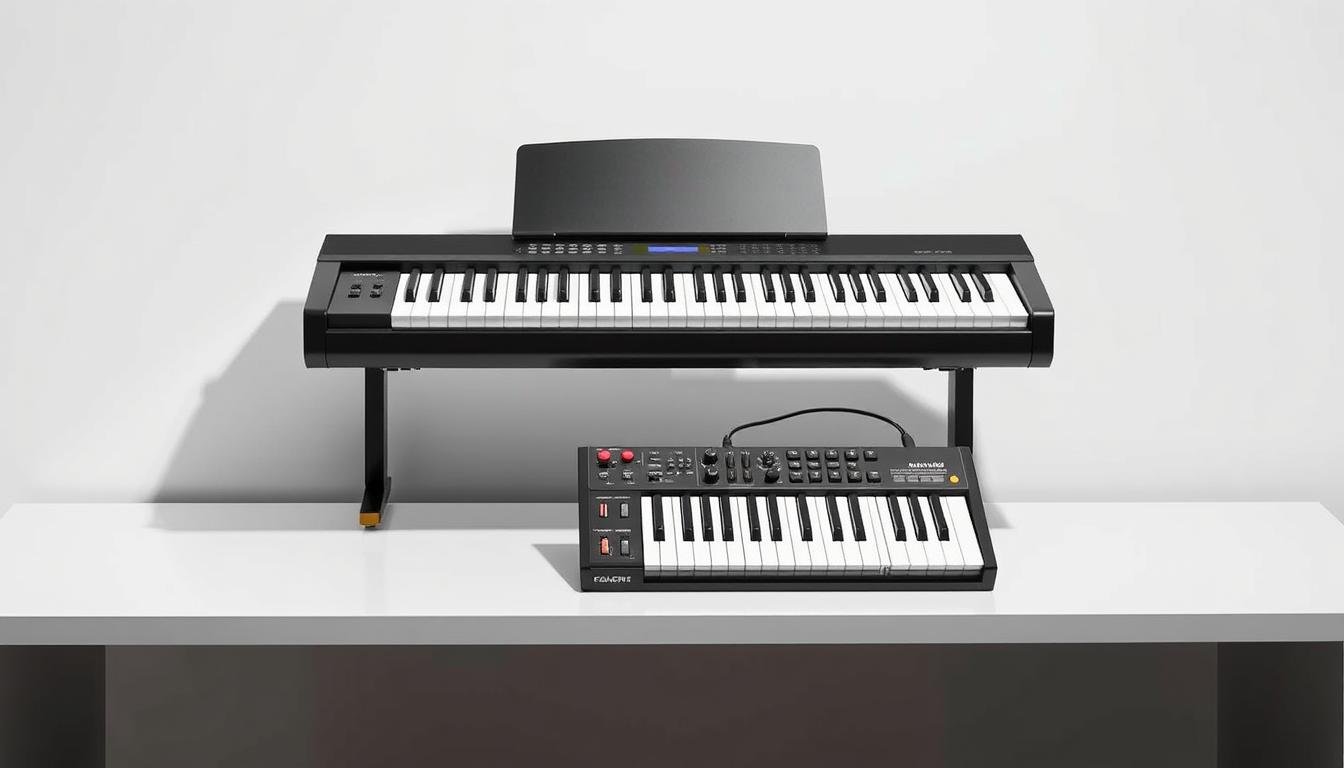
Choosing the right keyboard is key for beginners starting their musical journey. The first decision is whether to go for digital keyboards or traditional pianos.
Digital Keyboards vs. Traditional Pianos
Digital keyboards and traditional pianos have their own benefits. Digital keyboards are cheaper, need less upkeep, and come with cool features like different sounds and recording. Traditional pianos, on the other hand, offer a real playing feel and more expression.
Think about your budget, space, and what you like when choosing. For beginners, digital keyboards are often a better pick. They’re flexible and save money.
Key Features for Beginners
Some features make learning easier. Touch sensitivity lets you control sound with how hard you press. Polyphony is how many notes you can play at once without stopping others. Having lots of sounds and rhythms makes practice fun.
| Feature | Description | Importance for Beginners |
|---|---|---|
| Touch Sensitivity | Allows for dynamic sound control based on playing intensity | High |
| Polyphony | Determines the number of notes that can be played simultaneously | Medium |
| Sounds and Rhythms | Offers variety to keep practice sessions interesting | Medium |
Budget-Friendly Keyboard Recommendations
If you’re on a tight budget, there are still great keyboards for beginners. Look at Yamaha, Casio, and Korg. They have models with cool features like touch sensitivity and lots of sounds.
- Yamaha PSR-E263: A great entry-level keyboard with touch sensitivity and a variety of sounds.
- Casio SA-76: A simple, affordable option for young beginners.
- Korg B1: A digital piano with excellent touch sensitivity and sound quality.
By looking at these options, you can find the perfect keyboard to start your musical journey.
Understanding Keyboard Basics
To start playing the keyboard, you need to know its basics. Learning these will help you get better and enjoy playing more.
Keyboard Layout and Key Names
The keyboard layout shows how keys are arranged. Most keyboards have a standard layout. The white keys are labeled A to G, representing natural notes. The black keys are for sharps and flats.

Proper Hand Position and Posture
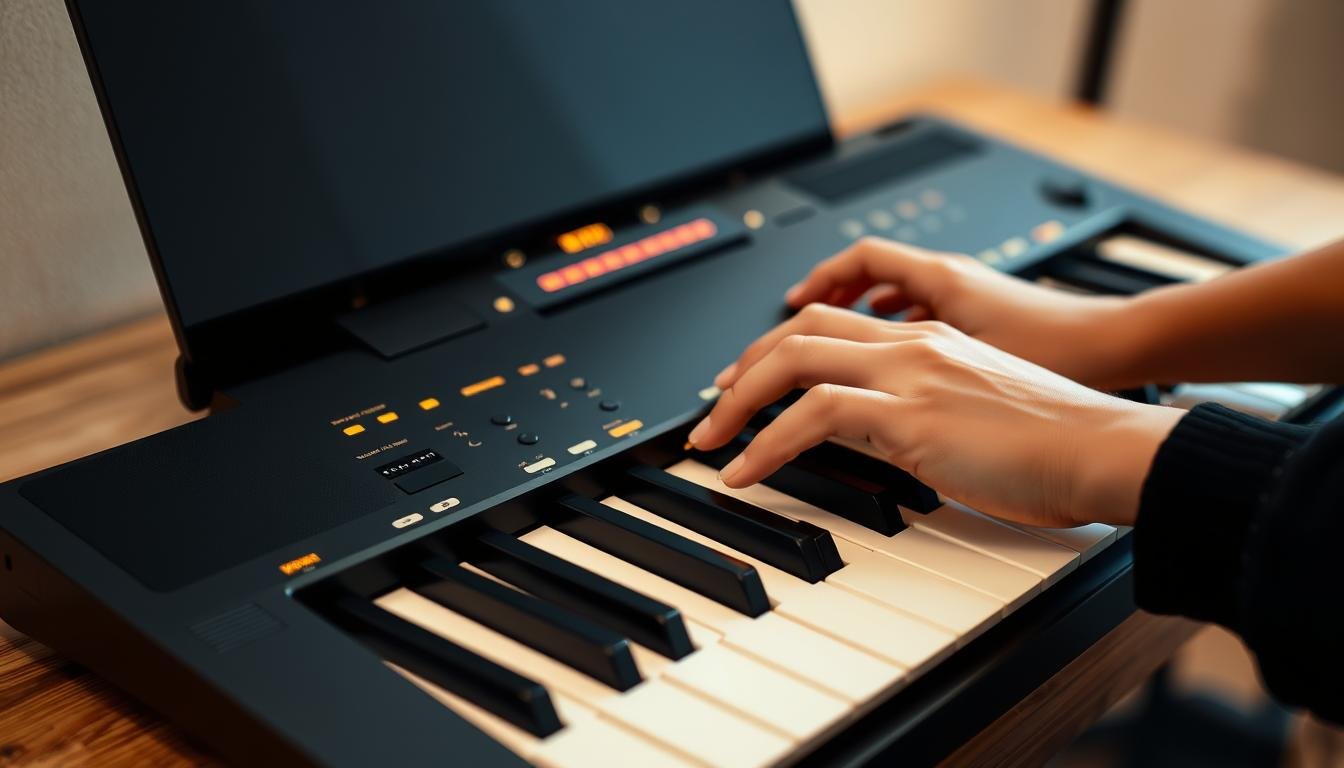
It’s important to play with the right hand position and posture. Keep your hands relaxed and curved. Sit straight with your feet flat, making sure the keyboard is at a good height.
Basic Finger Numbering and Technique
Finger numbering helps you know which finger to use for each note. Your thumb is finger 1, and your little finger is 5. Knowing this is key to playing well and improving your skills.
| Finger Number | Finger Name |
|---|---|
| 1 | Thumb |
| 2 | Index Finger |
| 3 | Middle Finger |
| 4 | Ring Finger |
| 5 | Little Finger |
Essential Accessories for New Keyboard Players
Improving your keyboard skills needs a few key accessories. These tools can greatly help your practice sessions. As a beginner, the right tools can make a big difference in your learning.
Keyboard Stands and Benches
A strong keyboard stand is key for good playing posture and less fatigue. Look for stands that adjust to fit your height and playing style. Also, a comfy bench or chair is important; a bench with a backrest adds extra support.
Headphones, Amplifiers, and Sustain Pedals
Headphones are great for quiet practice. Amplifiers boost your sound during shows. A sustain pedal lets you play more expressively. These tools can really improve your keyboard experience.
Learning Materials: Books, Apps, and Online Resources
There are many learning materials to help you with your keyboard. You can find books, apps, and online tutorials. Apps like Piano Maestro and YouTube tutorials are popular choices.
| Accessory | Description | Benefit |
|---|---|---|
| Keyboard Stand | Adjustable height for comfortable playing | Improves posture and reduces fatigue |
| Headphones | For quiet practice without disturbing others | Allows for practice at any time |
| Sustain Pedal | Enhances sound during play | Adds expressiveness to playing |
Keyboard for Beginners: Everything You Need to Start Playing
When you start playing the keyboard, having a good practice space is key. A well-set-up area makes learning fun and effective. It helps you focus better.
Creating an Effective Practice Space
For a great practice space, think about these things: – Comfort: Make sure your chair and keyboard are set up right for good posture. – Lighting: You need enough light to read music or guides. – Noise Level: A quiet spot helps you concentrate on playing.
Getting a good keyboard stand and keyboard bench is important. Also, headphones can keep you from disturbing others while you practice.

Establishing a Productive Practice Routine
Being consistent is crucial for learning the keyboard. A regular practice routine builds muscle memory and improves your skills. – Pick a time each day to practice. – Begin with short sessions (20-30 minutes) and grow them as you get better.
Keeping a practice journal or using a mobile app to track your progress can be very motivating. It helps you see how far you’ve come and what you need to work on.
| Practice Activity | Duration | Frequency |
|---|---|---|
| Scales and Arpeggios | 10 minutes | Daily |
| Song Practice | 15 minutes | 3 times a week |
| Theory and Reading | 10 minutes | Daily |
Setting Achievable Short and Long-Term Goals
Having clear goals keeps you motivated and focused on your keyboard journey. – Short-term goals might be learning a new song or mastering a technique in a week. – Long-term goals could be performing in front of people or finishing a keyboard course.
Breaking down big goals into smaller tasks makes learning easier and more satisfying. Celebrate your wins to stay motivated.
Learning Your First Notes and Music Theory
Playing the keyboard starts with learning your first notes and music theory. Knowing these basics lets you play simple songs and exercises with ease. It’s key to get to know the keyboard layout and the names of the notes.
Reading Basic Sheet Music and Notation
Reading sheet music is vital for keyboard players. It means understanding the musical notation system. This includes the staff, clefs, notes, rests, and other symbols.
To begin, focus on recognizing the notes on the staff. Also, learn about their duration and pitch.
Basic Notation Elements:
- Staff: The set of five lines where notes are placed.
- Clefs: Symbols that determine the pitch of the notes.
- Notes: Symbols representing sounds of different pitches and durations.
- Rests: Symbols indicating silence in the music.
Understanding Scales and Chord Structures
Scales and chords are key in music theory. Scales are sequences of notes in a specific order. Chords are groups of notes played at the same time.
Start with the C major scale. It’s easy to learn because it has no sharps or flats. Chords like C major and G major are also good for beginners.
Simple Exercises to Build Dexterity
Start with simple exercises to improve your dexterity. Play scales, arpeggios, and Hanon exercises. These will boost your finger strength, coordination, and technique.
For example, play the C major scale with your right hand, then your left hand, and both hands together. This will help your finger independence and dexterity.
Playing Your First Songs
Now that you’ve learned the basics, it’s time to play simple songs. This is the start of an exciting journey. You’ll get to use what you’ve learned and enjoy your hard work.
Easy Songs for Complete Beginners
Choosing easy songs is key to staying motivated and confident. Some great songs for beginners include:
- Mary Had a Little Lamb
- Twinkle, Twinkle, Little Star
- Chopsticks
These songs are simple and help you learn important skills. Playing simple melodies helps you get ready for harder songs.
Techniques for Using Both Hands Together
Coordinating both hands is a big challenge for beginners. Here are some tips to help:
- Practice each hand separately until you feel comfortable.
- Slowly practice playing both hands together, starting with slow songs.
- Use a metronome to keep a steady rhythm.
Regular practice is key to improving hand coordination. Start with simple exercises and then move to more complex songs.
Recording and Evaluating Your Progress
Recording your practice is a great way to track your progress. It lets you:
| Benefits | Description |
|---|---|
| Identify areas for improvement | Listen back to your recordings to find mistakes or areas needing more practice. |
| Track progress over time | Compare recordings from different times to see how much you’ve improved. |
| Boost motivation | Seeing your improvement can really motivate you to keep practicing. |
By following these steps and practicing regularly, you’ll be able to play simple songs. Recording your progress helps you see where you need to improve and keeps you motivated.
Learning Methods and Progression
As you keep learning on the keyboard, it’s key to check how you’re doing. Your learning style and progress can really affect your motivation and skill growth.
Self-Teaching vs. Formal Lessons
Learning keyboard can be done in two main ways: self-teaching or formal lessons. Self-teaching lets you learn at your own speed and in your own way. But, it might miss out on the structured help that formal lessons give. Formal lessons, though, offer personal feedback and a set plan, but they can cost more and be less flexible.
Whether you choose self-teaching or formal lessons depends on what works best for you. Some people find mixing both methods works well.
Online Courses and Video Tutorials
Online courses and video tutorials are getting more popular for learning keyboard. They give visual guidance and step-by-step instructions. This makes learning complex ideas easier. Sites like YouTube and online learning platforms have tutorials for all skill levels.
When and How to Advance to Intermediate Level
To move up to the intermediate level, you need to practice a lot and have a good plan. It’s important to assess your current skills and set realistic goals for moving up. Usually, it takes a few months of regular practice to reach the intermediate level, depending on how hard you work and the material you’re learning.
To move up well, focus on getting a solid base in music theory and technique. Then, start playing harder pieces.
Conclusion: Embracing Your Musical Journey
By finishing this guide, you’re starting a lifelong musical adventure. You’ve learned the basics of playing the keyboard, picked the right gear, and know how to practice well. You’re ready for success.
Your musical path is special, and it’s key to enjoy it. With regular practice, you’ll soon play your favorite tunes. The secret to getting better is to stay motivated and have fun while learning.
Keep exploring the world of keyboard playing. Remember, every famous musician began with the basics. Stay dedicated, and you’ll be amazed at your progress. Your keyboard skills will unlock new creative doors and let you express yourself in amazing ways.
Now, it’s time to move forward in your musical journey. Try new songs, explore different styles, and most importantly, keep playing. The music world is ready for you.
FAQ
What type of keyboard is best for a beginner?
For beginners, a digital keyboard is best. Look for one with touch sensitivity, lots of sounds, and a metronome. Brands like Yamaha, Casio, and Korg are great choices.
How long does it take to learn to play the keyboard?
Learning to play the keyboard takes time. It depends on how often you practice and how well you pick it up. With regular practice, you can play simple songs in a few weeks to months.
What are the essential accessories for a keyboard player?
You’ll need a keyboard stand, bench, and headphones. A sustain pedal is also important. Don’t forget learning materialslike books, apps, and online courses.
Can I learn to play the keyboard without formal lessons?
Yes, you can learn without formal lessons. Online tutorials and self-teaching are good options. But, lessons can give you personalized help and speed up your learning.
How often should I practice playing the keyboard?
Practice for 15-30 minutes a day, 3-4 times a week. This keeps your skills improving. Consistency is key.
What are some easy songs to start with for beginners?
Start with “Twinkle, Twinkle, Little Star”, “Mary Had a Little Lamb”, and “Imagine” by John Lennon. These songs are easy and help build your confidence.
How do I improve my hand position and finger technique?
Improve your hand position and finger technique with exercises. Try finger stretches, Hanon exercises, and simple melodies. Practice regularly and be patient.
Can I connect my keyboard to a computer or mobile device?
Many digital keyboards have MIDI or USB ports. This lets you connect to computers or mobile devices. It’s great for recording and using music software.
What is the difference between a digital keyboard and a traditional piano?
Digital keyboards use electronics to make sound, while traditional pianos use strings and hammers. Digital keyboards are portable and versatile. Traditional pianos offer a unique playing experience.
How do I care for and maintain my keyboard?
Keep your keyboard clean and dust-free. Avoid extreme temperatures or humidity. Use a cover or bag when not in use. Check and replace batteries or update software as needed.